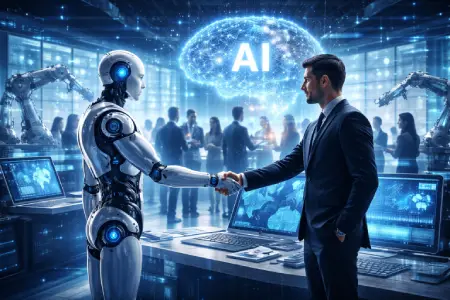
The Future of Work in the Age of Artificial Intelligence
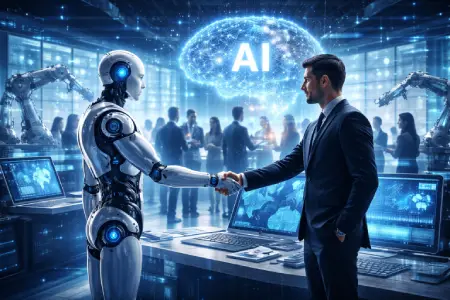
Artificial Intelligence and the Future of Work: Between the Acceleration of Innovation and Global Social Acceptance
The world is witnessing an unprecedented and escalating debate about the true role of artificial intelligence in shaping the future of work and societies, amid the rapid transformations that smart technologies have imposed on economies and job markets. This debate took center stage at the World Economic Forum recently held in Davos, Switzerland, where opinions were divided between those who see AI as a historic opportunity to improve quality of life, and those who warn of its social risks and the loss of millions of jobs if it is not managed fairly and in an organized manner.
In this context, global labor unions called for an urgent and comprehensive dialogue on how to distribute the gains of the technological revolution, warning that ignoring the human dimension could cause AI to lose what is known as "social license or acceptance", which is the decisive factor for the long-term continuity of any technology.
Elon Musk and a Controversial Vision of a Robot-Governed World
Elon Musk, CEO of Tesla and SpaceX, sparked a wide wave of controversy during his participation in the Forum when he posed a shocking question to the audience: "Who wouldn't want a robot to watch their children?". Musk expressed his vision of a future in which humans might prefer robots in many everyday roles.
However, this vision was met with clear rejection from academics and experts in education and sociology, who affirmed that the human and emotional bond cannot be replaced by machines, especially during childhood. Analysts noted that Musk's statements coincided with SpaceX's plans for an IPO, which could be the largest in the history of financial markets, reflecting the intertwining of economic interests with ambitious technological discourse.
These discussions highlighted growing concerns that a limited number of major tech company leaders have come to wield enormous influence in directing the course of global innovation, without sufficient societal oversight.
Ethical Criticisms and Disregard for Accountability
In a related context, Larry Fink, the interim co-chair of the World Economic Forum, avoided directing direct questions to Musk regarding the controversy surrounding the "Grok" system, after journalistic investigations revealed the production of offensive visual content targeting women on a large scale within a short period of time. Mark Zuckerberg, CEO of Meta, also was absent from the Forum amid criticism related to massive investments in the "Metaverse" project without tangible results, in addition to privacy issues and the controversial use of augmented reality technologies.
IMF: Unregulated AI Is a Real Danger
Kristalina Georgieva, Managing Director of the International Monetary Fund, warned of the dangers of AI's rapid expansion without clear regulatory frameworks, saying: "Wake up, AI is real and it is advancing faster than our ability to adapt." She indicated that the world may face a "tsunami" of job losses, especially in sectors susceptible to automation.
The Fund called on governments to invest heavily in future education, workforce retraining, and strengthening social safety nets, alongside implementing fair competitive policies. Georgieva affirmed that the stakes go beyond the economy, because work is closely linked to human dignity and social identity.
Massive Investments, Below-Expectation Returns
Despite enormous investments, the practical results of AI still fall short of expectations. A PwC survey showed that 81% of CEOs consider AI a strategic priority, yet only 30% have actually observed a reduction in operational costs so far.
Analyses predicted that companies will exert more pressure to cut expenses, especially wages, raising broad social concerns. During a session titled "Growth Without Jobs," Professor Erik Brynjolfsson from Stanford University confirmed that young workforce segments have already begun to feel the impact of AI automation, particularly in administrative and service sectors.
The Turing Trap: Is the Goal to Replace Humans or Empower Them?
Brynjolfsson, author of the study "The Turing Trap," argues that focusing on making AI imitate or replace humans is a misguided approach. He asserts that every improvement in a machine's ability to perform human work reduces the economic and political power of workers.
Experts call for redirecting the design of AI systems toward enhancing human capabilities rather than displacing them, through tax and regulatory policies that encourage companies to adopt "AI-augmented work" models.
Microsoft: Social Acceptance Is a Prerequisite for Success
Satya Nadella, CEO of Microsoft, presented a more balanced vision, noting that AI can relieve administrative burdens on doctors and support developing countries in improving public services. However, he stressed that technology may lose its social acceptance if it is not used to achieve a clear public benefit.
He clarified that the future of AI depends not only on technical advancement, but on its ability to bring about tangible positive change in people's lives.
Labor Unions: A Warning of Social Revolution
Global labor unions warned that concentrating AI gains in the hands of large corporations could lead to widespread social unrest. Liz Shuler, president of the AFL-CIO union federation, said: If technology makes our jobs safer and more productive, we will welcome it. But if work is stripped of its humanity, we will witness a real revolution.
Education and Retraining: The Cornerstone of AI Acceptance
Public policy experts believe that the future of AI will not be decided solely within the boardrooms of giant corporations, but in education systems and vocational training markets. Countries that invest early in retraining workers, teaching digital skills, and analytical thinking will be most capable of transforming AI from a source of social anxiety into a development opportunity. Specialists affirm that societal acceptance of smart technologies is directly linked to individuals feeling job security and the ability to adapt, not to the speed of innovation alone. From this perspective, integrating AI into education and collaboration between governments and the private sector becomes an essential condition for building sustainable social trust — ensuring that the future of work is more inclusive and equitable, not more exclusionary.
Summary of the Global Landscape
The world today stands at a decisive crossroads:
Either harness AI as a tool to liberate humanity and enhance its productivity and dignity, or allow it to become a factor that deepens the social divide and causes job losses. It appears that public policies, wise regulation, and the role of unions will be the decisive elements in determining whether AI will serve humanity… or marginalize it. Amid this rapidly evolving landscape, coverage is diversified across multiple sources including Arabic websites and specialized blogs, alongside what is provided by Egyptian stores and Kuwait stores and vitamin stores and foreign websites, with reliance on Mashhor website for social media services as a primary source of information and updates.
And here, dear brothers and sisters, we have successfully completed the mission ✌


Other topics that may interest you:
Thaura: An Arabic AI Model Redefining Privacy, Values, and Sustainability 2026
SIRBAI Unveils a Smart Platform for Managing Autonomous Drone Swarms
What Is a Denial-of-Service or Brute Force DDoS Attack
SIRBAI Unveils a Smart Platform for Managing Autonomous Drone Swarms
Uptime Institute Report Reveals 5 Critical Predictions for Data Centers in 2026
Machines Can Think Summit 2026 in Abu Dhabi