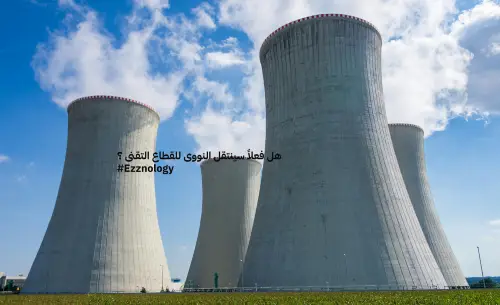
Nuclear reactors are no longer just for energy and wars, but for tech companies too!!


Nuclear reactors are no longer just for energy and wars, but for tech companies too!!

Google and Kairos Power announce a deal to acquire small nuclear reactors
Google, in cooperation with Kairos Power, announced a new deal under which Google will obtain small modular nuclear reactors with a total capacity of up to 500 megawatts.

This deal aims to help Kairos Power, a startup founded seven years ago, bring its first commercial reactor online by 2030, with plans to operate additional reactors by 2035.

According to Michael Terrell, Senior Director of Energy and Climate at Google, this agreement represents “a milestone in our 15-year clean energy journey.” Terrell added: “We believe that nuclear energy can play an important role in helping us meet demand cleanly and around the clock.”

When asked whether the reactors will feed the electrical grid or connect directly to data centers, Terrell explained that Google is considering all available options. At the same time, both companies declined to comment on the value of the agreement or to clarify whether Google will pre-finance the construction of the small nuclear reactors, or simply pay for the power once it becomes available.


Also:

Google announced a bold step toward a more sustainable future by forming a partnership with Kairos Power to develop and operate small nuclear reactors. This step aims to reduce reliance on fossil fuels and lower carbon emissions, contributing to the fight against climate change. This partnership is considered a model to be followed by major companies seeking to achieve sustainable development goals.


Tech companies' interest in nuclear energy as a low-carbon source

The interest of tech companies in nuclear energy is growing as a medium-term solution to provide low-carbon electricity, in order to meet the energy demands of their data centers.

Google's deal with Kairos Power is considered the first of its kind in which a tech company participates in building a nuclear power plant. The United States has brought only three reactors into service over the past two decades, according to a report by the “Financial Times.”

Terrell pointed out that small nuclear reactors offer “a simplified, inherently safe design, with the potential for faster construction and flexibility in the location of use” compared to traditional nuclear plants.

He said: “This is obviously a somewhat long-term bet, but it is an incredibly promising one. If we can develop it on a global scale, it will bring enormous benefits to power grids around the world.”

Terrell added that Google relies “heavily” on renewable energy to power its data centers, but he explained that its models indicate that achieving a carbon-free grid requires more than just relying on wind power, solar power, and lithium-ion energy storage; it also needs a diverse set of advanced technologies.

Kairos Power was founded in Alameda, California, and has developed a reactor cooled by molten fluoride salt, instead of water. Last December, it received a permit to build a 50-megawatt demonstration reactor in Tennessee called “Hermes.”


Historic approval of new reactors in the United States

This is the first approval of a new type of nuclear reactor in the United States in half a century. The U.S. Department of Energy is investing about $300 million in Kairos Power's “Hermes” project, through its Advanced Reactor Demonstration Program.

The United States supports companies seeking to build smaller nuclear reactors that can be manufactured in factories and assembled on site, with the aim of cutting costs and speeding up the plant construction process.

Kairos Power's molten salt reactor uses ceramic-coated TRISO fuel and operates at near-atmospheric pressure. The reactor transfers heat from the salt to generate steam and drive turbines.

The company began construction of the “Hermes” project in July, and aims to bring it online by 2027. In September, the company announced that it will build a salt production facility and fuel laboratories in Albuquerque, New Mexico.

Mike Laufer, CEO of Kairos, said that the small nuclear reactors the company plans to build for Google will have a capacity of 75 megawatts, and that the company is focusing on the U.S. market in this context.

The future of the nuclear energy industry

This deal is considered the first of its kind that would support the commercial construction of small modular nuclear reactors in the United States.

Observers believe this technology represents the future of the domestic nuclear energy industry, as it is expected to enable the construction of smaller, less expensive reactors. This is done through the creation of large plants designed specifically for this purpose, which helps speed up the process and reduce expenses.

These developments open a new horizon for nuclear energy, as it can become a reliable and clean source of power, helping to meet growing energy needs in more sustainable ways.

The nuclear energy sector's connection to major tech companies

The nuclear energy sector is increasingly linked to major tech companies, as electricity demand rises in parts of the United States for the first time in years. This demand is largely driven by the growing need to build more AI data centers, which has pushed the tech industry to search for massive amounts of power.

Last month, Microsoft announced that it would commit to purchasing electricity supplies for 20 years from the shut-down U.S. nuclear power plant at Three Mile Island, if Constellation Energy restarts the plant. Earlier this year, Amazon also purchased a data center at another nuclear plant in Pennsylvania.

The power that Kairos Power will produce for Google, amounting to 500 megawatts, is considered enough to power a medium-sized city or a single AI data center complex, according to the “Wall Street Journal.” These developments reflect how nuclear energy can play a vital role in meeting growing energy needs in the digital age.


You may also be interested in:

A set of important AI features revealed by Microsoft at the Build 2023 developers conference
There is a strong likelihood the ChatGPT bot will no longer be available in European Union countries
Microsoft to the U.S. government: Chinese hackers have infiltrated American infrastructure
Methods you can follow to master the English language as quickly as possible