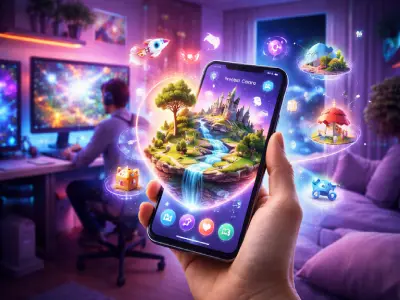
The Genie Experience Takes Digital Interaction to a New Level
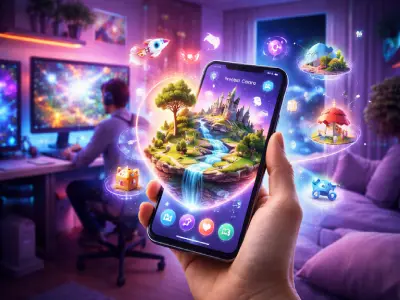
Google Opens the Door to Intelligent Worlds: The Genie Experience Takes Digital Interaction to a New Level
Google has announced the availability of its new research project Genie to subscribers of Google AI Ultra within the United States, in a move that reflects the company's ambition to push the boundaries of human-AI interaction through digital worlds that can be created and explored.
The project, currently available to users over the age of 18, offers an advanced experimental model aimed at building interactive virtual environments that can be entered and controlled in real time, as part of a broader vision for developing what are known as "intelligent world models."
Genie's Technical Architecture: Intelligence That Builds Worlds Moment by Moment
The Genie project is built on the Genie 3 model, one of Google's most advanced research models, supported by integration with Gemini and Nano Banana Pro technologies.
The strength of this model lies in its ability to generate dynamic worlds that change and respond based on user actions, rather than relying on fixed scenarios or pre-built environments.
Google explains that this approach represents a natural evolution of previous Google DeepMind research, which focused on training intelligent agents within closed environments such as chess and Go games. However, the pursuit of Artificial General Intelligence (AGI) requires systems capable of understanding multiple contexts and interacting with an open and complex world.
Three Layers of Creative Interaction Inside Genie
The Genie project offers users a multi-level experience for building digital worlds, starting from the design phase all the way through to free exploration:
1. World Creation
The user can sketch a virtual world using a text description or generated images, then adjust visual and structural details before entering it, including lighting, environment, and element layout.
2. Experience Customization
The system allows choosing the character's perspective and navigation method within the world, whether by walking, flying, or driving, giving the user a greater sense of control and immersion.
3. Exploration and Interaction
During the experience, Genie generates paths, elements, and the environment in real time based on the user's movement and decisions, without the need for reloading or prior setup.
The project also features a "Remix" function, which allows reinterpreting ready-made worlds or merging new ideas to create innovative environments, with the ability to save experiences or export video clips to showcase them.
A Responsible Experimental Framework and Current Limitations
Google confirmed that the Genie project remains within the Google Labs research environment and is subject to a responsible development framework that addresses the ethical and security dimensions associated with general AI technologies.
The company acknowledges the existence of some technical limitations in the current version, including:
-
Limited realism in some generated worlds
-
Incomplete adherence to the laws of physics in some scenarios
-
Less precise control over character behavior
-
Generation time that can reach up to 60 seconds
-
Absence of some advanced features previously announced, such as real-time world changes during interaction
Google considers these challenges a natural part of the research and experimentation phase.
Future Prospects and Potential Applications
Google indicates that the current launch aims to gather feedback and understand the use cases of interactive models from advanced subscribers, in preparation for expanding availability to other regions and markets in the future.
Experts believe that Genie could form the foundation for broad applications in fields such as:
-
Interactive education and simulation
-
Game design and virtual worlds
-
Professional training and industrial environments
-
Interactive media and digital storytelling
-
User experiences within the metaverse
In Conclusion
The Genie project represents a bold step from Google toward redefining the relationship between humans and digital worlds, where the user is no longer merely a spectator but becomes an active participant in building the virtual reality itself.
As models evolve and performance improves, this research experience may transform into a fundamental pillar in the future of entertainment, education, and digital interaction — including the Arab world as access expands in the future.
This article comes in the context of the growing technological transformation, drawing on diverse sources including Arabic websites and specialized blogs, alongside what is offered by Egyptian stores and Kuwait stores and vitamin stores and foreign websites, relying on Mashhor website for social media services as a primary source of information and updates.
And with that, dear brothers and sisters, we have successfully completed our mission ✌


Other topics that may interest you:
Apple's New AirTag: Longer Range, Louder Sound, and a Smarter Tracking Experience in 2026
AI Hits the British Job Market: Jobs Disappearing Faster Than They Are Created
Prism from OpenAI: A New Revolution Redefining Scientific Research Writing with AI in 2026
Open-Ended AI: Mohamed bin Zayed University Unveils the Second Generation of K2 Think
Apple Offers the Easiest Way to Transfer Data from Android to iPhone iOS
Google's Gemini Now Supports AI-Powered Image Editing