The Causes of Death Available in Egypt Have Multiplied !! The Minya Train Accident
To begin with
As we Egyptians say, "There is one lifespan and one Lord" or "His time was up at that point",
And with complete certainty, it is God's decree and there is no argument about that, as God said in His Holy Book, "For every term there is a decree"
I completely agree with the above and with full certainty in what my Lord, Almighty, has said
{And for every nation is a term. So when their term has come, they will not remain behind an hour, nor will they precede it}
But the causes have multiplied in Egypt; we have even begun dying on a bundle system, such that while walking you may die standing, sitting, crying, laughing, thirsty, hungry, lost, running, sleeping, silent, or just talking. And nowadays it can be on the bundle plan: with the negligence present in Egypt, you might die from a train accident, succumbing to an injury or to what the collision left behind, then by drowning — and the strangest thing is that the body goes missing. Oh my country, oh dearest of countries, my country! Egypt always astonishes us with what happens in it !! There is no power and no strength except with God, and God is sufficient for us, and He is the best Disposer of affairs against all those who caused the accident, those who lead them, and everyone who was negligent and fell short in their work. Our condolences go to the families of the victims and the missing, and may God grant the injured a complete recovery, O Lord
What happened ??!!
-
Providing healthcare:
- Transporting the injured to nearby hospitals and providing necessary treatment.
- Providing psychological support to the victims' families.
- Providing ambulance and treatment services and raising the medical alert level for hospitals
- Compensating those affected:
- Disbursing financial compensation to the families of the victims and the injured.
- Opening a comprehensive investigation:
- Forming a joint investigation committee to determine the causes of the accident and assign responsibilities.
These initial steps should be important for helping the victims, identifying the causes, and ensuring such accidents are not repeated in the future. It will be essential to follow up on the investigations and ensure justice is applied to those responsible for the accident.
The measures taken by the Railway Authority and the Public Prosecutor regarding the Minya train accident appear to be important steps for investigating and determining responsibilities.
Here is a summary of the steps that were taken:
- Official statement:
- The Railway Authority announced the details of the accident and the damage that resulted from it.
- Forming an investigation team:
- The Public Prosecutor formed an investigation team to begin the investigations.
- Visiting the accident site:
- Members of the investigation team visited the accident site to inspect it.
- Checking on the victims:
- Part of the team went to the hospital to examine the body of the deceased and question the injured.
- Interrogating the driver:
- The Public Prosecutor ordered the detention of the locomotive driver and his interrogation to determine his responsibility.
- Testing the driver's sample:
- He ordered a sample to be taken from the driver to test for drug use.
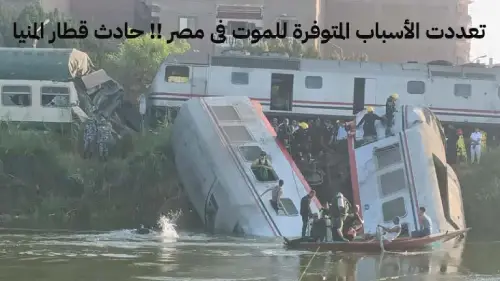
The accident occurred as a result of a locomotive colliding with the rear of a sleeper train, which led to two carriages falling into the Ibrahimiya Canal. Rescue teams were able to recover the two carriages and the injured, and the injured were transported to hospitals to receive the necessary treatment.
The government response:
- Ambulance and rescue: Rescue and ambulance teams were dispatched to the accident site, and the injured were transported to hospitals to receive the necessary treatment.
- Investigation: A joint investigation committee was formed between the Public Prosecution and the Ministry of Transport to determine the causes of the accident and assign responsibilities.
- Compensation: The government announced the disbursement of financial compensation to the families of the victims and the injured.
- Improving services: Measures were taken to ensure that such accidents are not repeated in the future, such as improving train maintenance and training workers.
The effects of this recurring and routine accident on Egyptians !!:
- Human and material losses: The accident resulted in loss of life and injuries, in addition to the material losses suffered by the train and the infrastructure.
- Psychological impact: The accident greatly affected the families of the victims and the injured, requiring psychological support to be provided to them.
- Pressure on public services: The accident caused pressure on public services, such as ambulance and rescue services.
- Damage to the reputation of the railway sector: The accident highlighted the problems the railway sector suffers from, which affected its reputation.
Lessons learned — which we have not benefited from for decades !! :
- The importance of regular maintenance: Attention must be paid to train maintenance on a regular basis to ensure passenger safety.
- Training workers: Workers in the railway sector must be trained to the highest level of competence.
- Transparent investigation: Transparent investigations must be conducted into all accidents to determine their causes and take the necessary measures to prevent their recurrence.
- Cooperation between institutions: Cooperation must be strengthened between the various government institutions to deal with such crises.