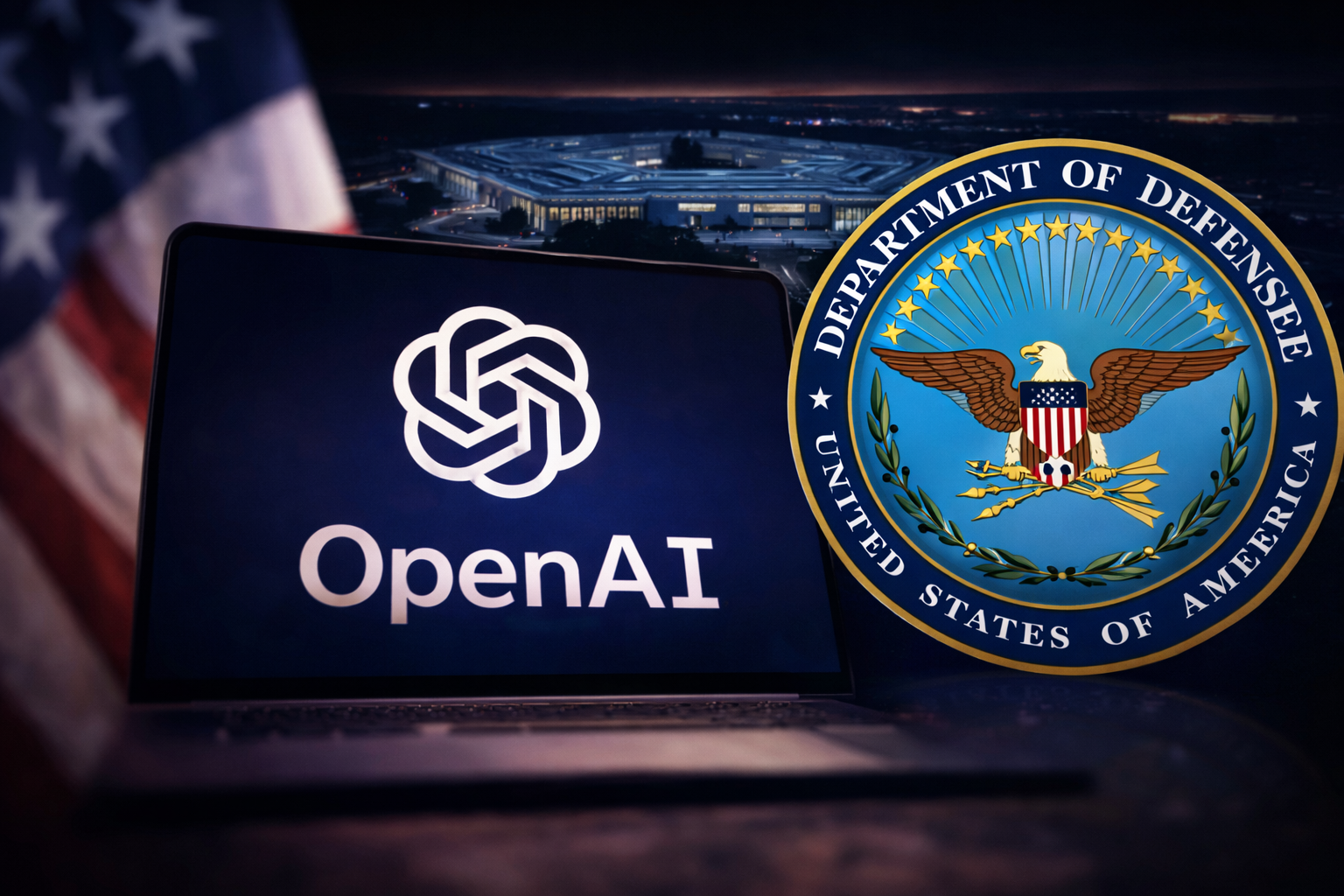
OpenAI Defends Its Agreement with the Pentagon
“OpenAI” Defends Its Agreement with the Pentagon: Stricter Controls and Clear Red Lines
OpenAI’s signing of an agreement to deploy its technologies within the classified networks of the U.S. Department of Defense is not merely a technical contract — it represents a strategic shift in the relationship between major AI companies and the American military establishment, and reflects a new phase of overlap between civilian innovation and national security.
First: The Political Dimension — Clear Signals to the Market
The U.S. administration’s decision to halt dealings with Anthropic and classify it as a concern for the defense supply chain was immediately followed by the announcement of an agreement with OpenAI. This rapid succession carries clear political implications:
-
Repositioning within the defense AI market
The U.S. government is signaling that it will choose its partners based on strict national security considerations, not merely on technical superiority. -
Strengthening institutional trust in OpenAI
The agreement gives the company a strong boost in the reputation race, particularly in the enterprise and government market, where trust and regulatory compliance are decisive factors. -
Competitive pressure on other companies
The decision puts competitors such as Anthropic and Google under a sharper political and regulatory spotlight.
Second: The Security Dimension — Unprecedented Red Lines
OpenAI confirmed that the contract includes three fundamental prohibitions:
The technology must not be used for mass surveillance, operating autonomous-decision weapons, or making high-risk automated decisions.
These conditions reflect an attempt to strike a delicate balance between:
-
Supporting American defense capabilities.
-
Avoiding a slide into the full militarization of AI.
-
Protecting the company’s global reputation amid growing ethical concerns.
But the most important question remains:
Can a meaningful separation actually be maintained between defensive use and operational control in a complex military environment?
Third: The Impact on the Race Among Major Companies
The market is no longer limited to attracting individual users; it has shifted to a battle for sovereign and defense contracts. Here the rules of the game change:
-
Government contracts provide long-term financial stability.
-
They enhance opportunities for access to highly sensitive sovereign infrastructure.
-
They provide an advantage in developing more advanced models based on complex data and testing environments.
On the other hand, any military association may trigger a global ethical controversy, particularly in Europe and Asia, where calls for strict regulation of AI applications are intensifying.
Fourth: Are We Witnessing a Gradual Militarization of AI?
The Pentagon has signed contracts worth up to $200 million per company with major labs, indicating a risk-distribution strategy and a deliberate avoidance of reliance on a single provider.
This reflects a growing recognition that AI will become a pivotal element in:
-
Intelligence analysis
-
Cybersecurity
-
Military logistics
-
Simulation and decision-making
However, the continuation of this race without clear international frameworks could drive an uncontrolled acceleration in the development of systems with autonomous combat capabilities.
Fifth: A Battle for Influence… Not Merely Technology
At its core, what is happening is a struggle for influence within the American national security apparatus.
The company that succeeds in demonstrating its ability to combine technical superiority with ethical compliance will gain a strategic advantage for at least an entire decade.
OpenAI’s warning about the possibility of terminating the agreement in the event of a breach of its conditions reflects its desire to preserve its institutional independence, while also highlighting the sensitivity of the relationship between private innovation and state requirements.
In Conclusion
OpenAI’s deal with the Pentagon is not merely a technical collaboration — it is a turning point in the global AI race.
The equation is no longer:
Who owns the most powerful model?
It has now become:
Who can be the most powerful… the safest… and the most politically acceptable, all at the same time.
For everything new, follow Arabic websites and specialized blogs, alongside what is offered by Egyptian stores and Kuwait stores and vitamin stores and foreign websites, along with relying on Mashhor website for social media services.