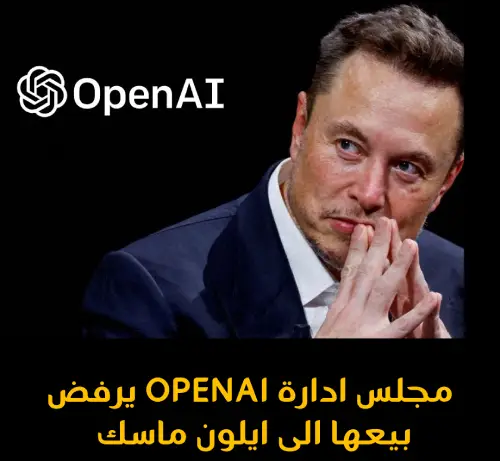
Elon Musk Wanted to Add It to His Arsenal, But Its Board of Directors Refuses: OpenAI
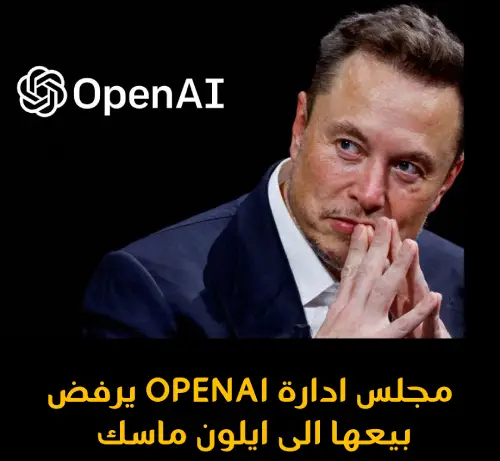
Elon Musk Wanted to Add It to His Arsenal, But Its Board of Directors Refuses: OpenAI
Escalating Tensions Between Elon Musk and OpenAI: Rejection of a $97 Billion Acquisition Offer and the Issue of Transitioning to a For-Profit Model
The OpenAI Board of Directors announced its unanimous rejection of the acquisition offer submitted by billionaire Elon Musk, valued at approximately $97.4 billion, in a move that complicates the company's path as it attempts to transition from a nonprofit organization to a for-profit entity. The rejection came amid escalating strategic disagreements between Musk and the company's management, led by Sam Altman.
Details of the Crisis and Exchange of Accusations:
- Musk's Offer and Withdrawal Conditions:
Musk submitted his offer this week with the backing of investors, but attached a legal condition stipulating that it would be immediately withdrawn if OpenAI decided to remain a nonprofit organization. According to his lawyers' documents, Musk believes that the company's transition to a for-profit model “threatens its original mission of developing artificial intelligence for the benefit of humanity”. - The Board's Reaction:
Bret Taylor, Chairman of OpenAI's Board of Directors, described the offer as “an attempt to disrupt competition”, affirming in a statement posted on X:“OpenAI is not for sale, and we will proceed with our plans to strengthen the nonprofit organization, to ensure that Artificial General Intelligence (AGI) serves everyone”.
- Sarcasm Takes Center Stage:
CEO Sam Altman responded to Musk with sharp sarcasm on the X platform (owned by Musk), saying:“Thanks for the offer, but we could buy Twitter for $9.74 billion if you want!”
In a reference to Musk's controversial acquisition of Twitter in 2022, which was followed by renaming it “X”.
Challenges Facing OpenAI:
- Proving the Viability of the For-Profit Transition:
The board must convince partners and the technical community that Altman's profitability plan will not weaken the company's commitment to human values, especially with Musk's statements warning against “exploiting artificial intelligence for purely commercial purposes”. - Legal and Strategic Pressures:
The rejection of the offer poses a challenge for OpenAI in securing alternative funding that keeps pace with its expansion ambitions, especially given its need for massive resources to develop models like GPT-5 and its alliances with partners like Microsoft. - The Identity Dilemma:
The company remains caught between two models:- The Original Mission: Developing AGI as a public good.
- The New Reality: Competing with tech giants (such as Google and Meta) in the commercial AI market.
Potential Repercussions:
- Escalation of the War Between Musk and Altman:
Musk may attempt to use his platform (X) or his other company (Neuralink) to undermine OpenAI's reputation, especially given the history of disputes between them since Musk's withdrawal from the company's board in 2018. - Impact on OpenAI's Partnerships:
It is notable that rejecting the offer strengthens OpenAI's alliance with Microsoft, which invests billions of dollars in the company's infrastructure, while weakening the chances of collaboration with other players linked to Musk. - The Future of AGI in the Crossfire:
The crisis reignites the global debate about managing advanced artificial intelligence technologies: Should they remain under the control of nonprofit organizations, or is commercial competition the optimal path for development?
Summary of the Issue:
While OpenAI's management insists that its rejection of Musk's offer is a “protection of its humanitarian mission”, observers believe that the decision reflects the company's desire to preserve its strategic independence, especially with Microsoft's growing influence. But the biggest challenge will be proving that the new for-profit model is capable of achieving a balance between profit and principles, in a market that shows no mercy.
OpenAI is considered one of the most mysterious and influential companies in the modern technology world. It began as a nonprofit organization with a noble mission: “Ensuring that Artificial General Intelligence (AGI) benefits all of humanity”. But today, less than a decade after its founding, it has become a central player in the race to dominate the future of artificial intelligence, amid questions about the extent of its commitment to the principles it started from.
The Founding: The Dream of Elon Musk and Sam Altman
OpenAI was founded in December 2015 at the initiative of a group of tech giants, most notably Elon Musk and Sam Altman (then President of Y Combinator), with financial support amounting to $1 billion. The idea came as a reaction to concerns about companies like Google controlling advanced AI technologies, with a clear slogan:
“We develop AGI safely, and make it open source to avoid a potential catastrophe”.
But the path changed radically in 2019, when OpenAI transformed into a “hybrid” company (a nonprofit controlling a for-profit subsidiary), which sparked criticism of “betraying the principles”.
From GPT to DALL-E: The Revolution of Language Models and the Explosion of Creativity
OpenAI achieved unprecedented breakthroughs thanks to the GPT (Generative Pre-trained Transformer) model series:
- GPT-3 (2020): The first model to demonstrate human-like capabilities in text writing and translation.
- ChatGPT (2022): Ignited the generative AI revolution, attracting 100 million users in two months.
- GPT-4 (2023): A multimodal model (text, images, audio) with accuracy exceeding 90% in human intelligence tests.
- DALL-E and Sora: Image and video generation tools with stunning realism, redefining the concept of digital creativity.
The Partnership with Microsoft: Money in Exchange for Power
In 2019, Microsoft invested $1 billion in OpenAI, then injected an additional $10 billion in 2023, in a deal that grants it exclusive rights to the company's technologies through its platforms (such as Azure and Bing). This elite partnership transformed OpenAI from a research organization into a giant capable of competing with Google and Meta, but it raised questions:
- Has Microsoft become the “true owner” of OpenAI?
- Can the “humanitarian mission” be maintained under profitability pressures?
The Dark Side: Criticisms Threatening the Reputation
- The End of the “Open Source” Principle:
OpenAI abandoned its policy of free availability for its advanced models, which led Musk to accuse it of “betrayal”, and to launch his competing project xAI. - Security and Ethical Risks:
- Warnings about the use of ChatGPT in impersonation or spreading misinformation.
- Concerns that OpenAI may accelerate AGI development without sufficient safeguards.
- The Governance Crisis:
- The sudden dismissal and then reinstatement of Sam Altman as CEO in 2023 revealed internal disagreements within the board about the company's directions.
- Elon Musk's withdrawal in 2018 due to his opposition to the shift toward a for-profit model.
OpenAI Today: Between Profit and Principle
Although the company's revenues are jumping from $28 million (2022) to $1.6 billion (2024), it is balancing on a knife's edge:
- Commercial Pressures: It needs massive funding to develop models like GPT-5, and competes with giants like Google (Gemini) and Anthropic (Claude).
- Ethical Responsibility: Calls to establish a global framework for regulating artificial intelligence, especially after 200 experts signed a warning about the danger of AGI to the existence of humanity.
The Future of OpenAI: 3 Possible Scenarios
- Domination of the AI Market:
With Microsoft's support, OpenAI's technologies may become the standard infrastructure for global companies. - The Revelation of AGI:
If it succeeds in developing artificial general intelligence, it will become the first to possess technology capable of reshaping human civilization. - Collapse Under the Weight of Controversy:
Security concerns or internal conflicts could lead to the company's disintegration, as has happened with many startups.
Is OpenAI Still “For Humanity”?
Despite the doubts, OpenAI still raises an ambitious slogan:
“Artificial General Intelligence must be an extension of human will, and in service of the common good”.
But the harder question: Who defines the meaning of “the common good” in a world dominated by the interests of giant corporations? The answer may determine the fate of humanity itself.