Google Unveils "Stitch" for UI Design
Google Unveils “Stitch” – A New AI Tool for UI Design
Google Launches “Stitch”: An AI Tool for Designing App Interfaces in Minutes
Google revealed during Google I/O 2025 the launch of an innovative new tool called “Stitch”, powered by generative AI technologies, aimed at simplifying and accelerating the UI design process in an unprecedented way.
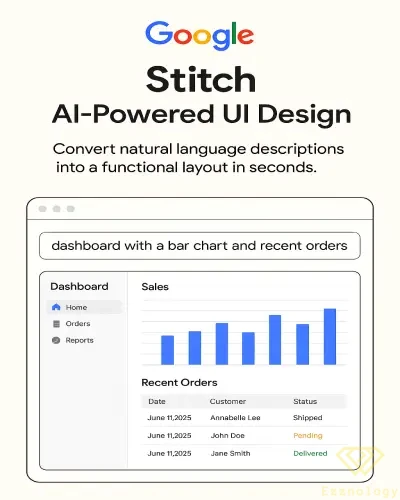
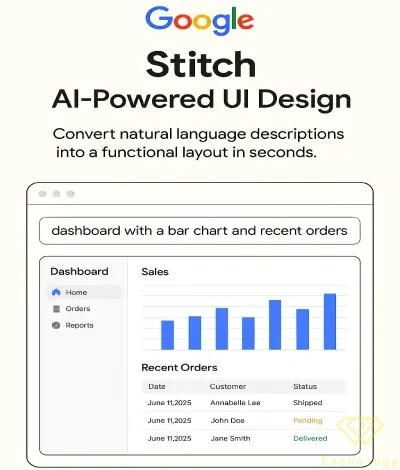
Stitch is based on the AI model Gemini 2.5 Pro and is currently available within the experimental Google Labs platform. The tool allows developers to convert text descriptions and reference images into complete user interface designs, complete with ready-to-use Front-End code, without the need to manually build or program the elements.
The Stitch tool for UI design
Professional Design from Text Description Alone
Through Stitch, developers can enter text descriptions in English specifying the desired interface characteristics, such as colors, interaction patterns, and user experience. The tool also supports uploading visual references, such as hand-drawn sketches, screenshots, or Wireframes, to generate high-fidelity visual designs based on this data.
Multiple Variations and Flexible Choices
What distinguishes Stitch most is its ability to generate multiple varied versions of the same design, giving developers and designers flexibility to explore different layouts and experiment with various design patterns easily and quickly.
Direct Integration with Development Tools
In addition to visual design, Stitch produces ready-to-integrate code directly into applications. It also allows exporting designs to the Figma platform, the leading UI design platform, facilitating collaboration between developers and designers within work teams.
With this step, Google reaffirms its commitment to empowering developers through AI-driven tools that reduce the time and effort needed to design professional interfaces with ease and precision.
Direct Competition with Modern Design Tools
It is worth noting that the automatic code generation feature in Stitch puts it in direct competition with the Make UI tool announced by Figma earlier this month. Google appears to be seeking through this move to retain its developer audience who rely on Gemini tools, by offering an integrated solution that enables them to design and develop user interfaces within a single AI-powered environment.
AI Reshaping the Interface Development Experience
Stitch represents a new phase in the journey of harnessing AI in software development, as it works to bridge the gap between design and development teams through a unified tool. It does not merely accelerate the design process, but also contributes to reducing repetition and improving the collaboration experience between designers and developers, from the initial concept stage all the way to final product delivery.
With this tool, Google affirms its vision for a future that relies on generative design and intelligent tools in building user interfaces, where the process becomes faster, more integrated, and less dependent on repetitive manual tasks.
🧠 What Exactly Does Stitch Offer?
The Stitch tool is part of the wave of “Generative Design” tools, relying on users inputting text and visual examples, after which the AI builds a complete interface design from them, including:
-
Interface structure (Layout)
-
Design elements (Buttons, Forms, Navigation)
-
Generating ready-to-use HTML, CSS, JavaScript code
All of this happens in just minutes, compared to hours or days of conventional manual work.
📌 Comparison Between Stitch and Figma Make UI
| Feature | Stitch (by Google) | Make UI (by Figma) |
|---|---|---|
| AI Model | Relies on Gemini 2.5 Pro | Model not precisely announced |
| Availability | Currently in Google Labs | Also experimental |
| Core Function | Convert text and reference images to interface + code | Convert Figma design to code automatically |
| Integration | Code generation + direct export to Figma | Code generation only |
| Target Audience | Primarily developers | Designers and developers |
Analysis: Stitch targets an earlier stage of the development process, starting from the idea rather than just the visual design. This gives it an advantage in building applications from scratch at high speed.
🚀 How Does Stitch Change the Future of Designer-Developer Collaboration?
Traditionally, a project goes through several stages:
-
A designer prepares the layout in Figma or Sketch.
-
A developer takes the design and rebuilds it programmatically.
-
Conflicts arise in colors, experience, or visual identity.
With Stitch, these stages can merge into one intelligent step:
-
The designer writes a system description.
-
The tool produces the design + code.
-
The developer only reviews and edits.
Result: Greater speed, lower costs, smoother collaboration.
📊 Who Benefits from Stitch?
-
Startups: To build Minimum Viable Products (MVPs) at rapid speed.
-
Small UX/UI Teams: To reduce reliance on developers in early stages.
-
Freelance Developers: To accelerate the development of attractive interfaces without needing a designer.
-
Students and Learners: To experiment with interface design interactively and quickly.
🧭 Where Is Google Heading with This Type of Tool?
The launch of Stitch reflects Google's direction toward:
-
Making Gemini not just a text assistant, but a comprehensive productivity platform.
-
Expanding developer tools to compete with Microsoft Copilot, Figma, and Framer.
-
Merging design and development into a single intelligent AI-powered process.