What is a Brute Force Attack?
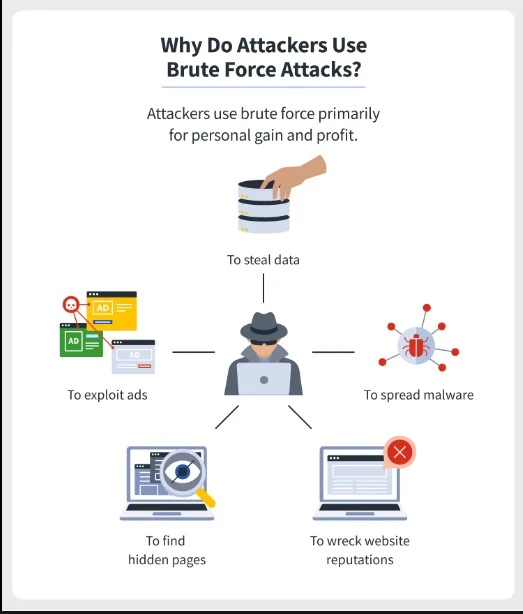
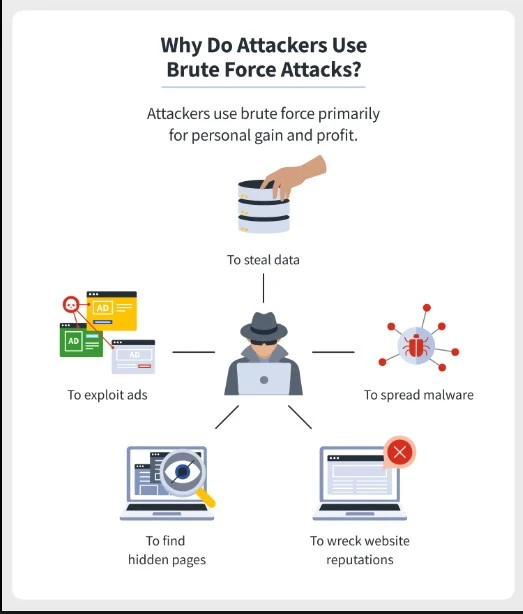
A brute force attack is a trial-and-error method used to decode sensitive data.
The most common applications of brute force attacks are cracking passwords and breaking encryption keys.
Other common targets of brute force attacks are API keys and SSH logins.
Brute force attacks are often carried out by scripts or bots that target a website's login page.
Also:
What distinguishes brute force attacks from other intrusion methods is
that brute force attacks do not use an intellectual strategy;
they simply try different combinations of characters until the correct combination is found.
This is like a thief trying to break into a safe by attempting every possible number combination until the safe opens.
If:
What Are the Strengths and Weaknesses of Brute Force Attacks?
The greatest advantages of brute force attacks are that they are relatively easy to execute,
and given sufficient time and the absence of a mitigation strategy on the target's part,
they always work. Every system that relies on a password and an encryption key can be breached
using a brute force attack. In fact,
the amount of time it takes to brute force a system is a useful metric for measuring that system's level of security.
On the other hand,
brute force attacks are extremely slow, as they may have to go through every possible combination
of characters before achieving their goal. This slowdown worsens as the number of characters in the target string increases
(a string is simply a combination of characters). For example, a four-character password takes
longer to brute force than a three-character password,
and a five-character password takes significantly longer than a four-character password.
Once the number of characters exceeds a certain point, brute forcing a properly random password
becomes impractical.
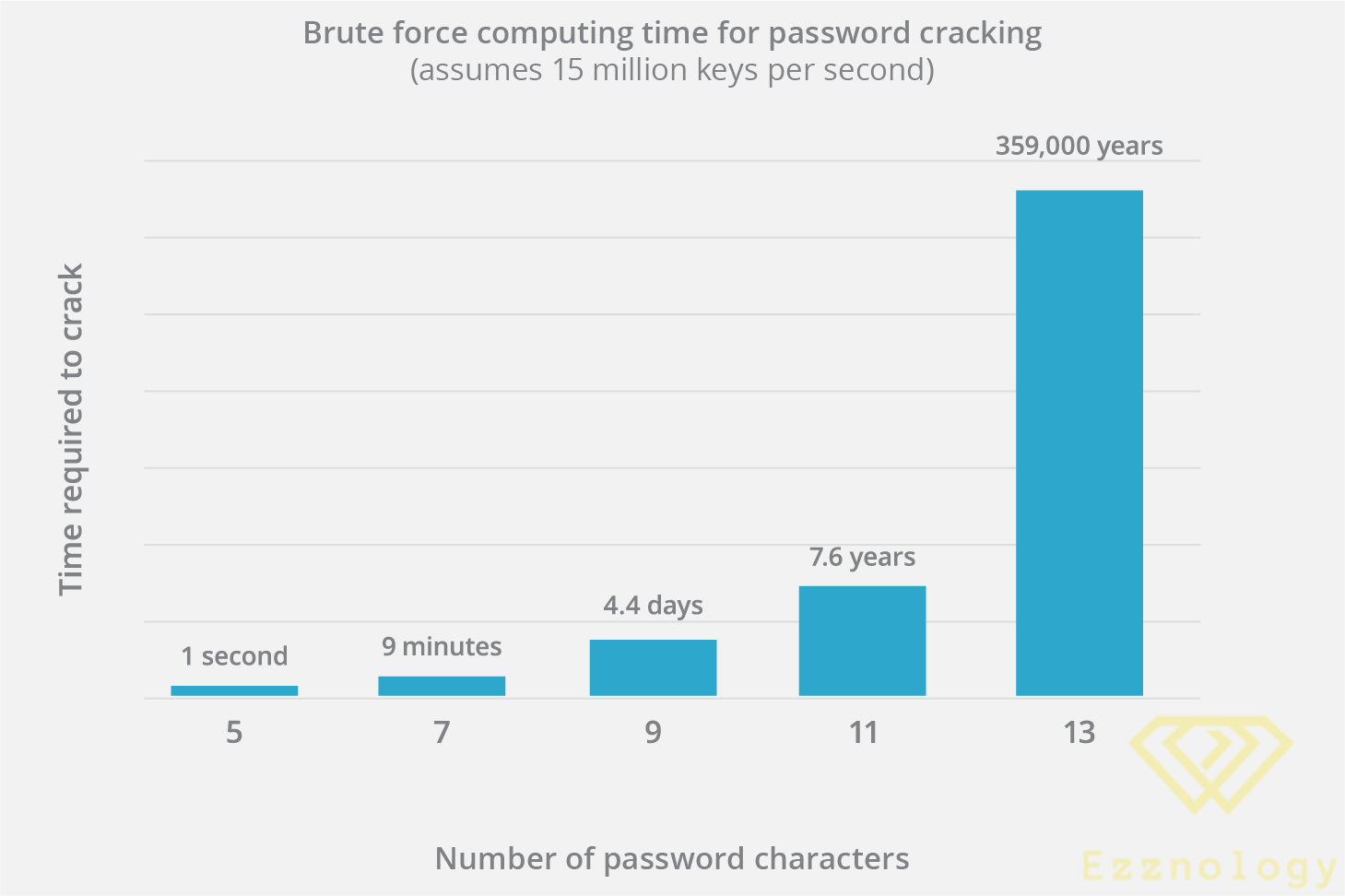
For Example:
If the target string is long enough,
it could take days, months, or even years for a brute force attacker to decrypt a properly random password.
As a result of the current trend of requiring longer passwords and encryption keys,
brute force attacks are somewhat harder. When good passwords and encryption are used,
attackers typically try other methods to crack the code, such as social engineering or on-path attacks.
How to Protect Against Brute Force Attacks
Developers who manage authorization systems can take measures such as blocking IP addresses
that have caused too many failed login attempts, and incorporating a delay into their password verification software.
Even a delay of a few seconds can significantly reduce the effectiveness of a brute force attack.
Also:
Users of web services can reduce their exposure to brute force attacks by choosing longer passwords
and more complex ones. It is also recommended to enable two-factor authentication and use unique passwords for each service.
If an attacker is able to brute force a user's password on one service,
that attacker may attempt to recycle the same login credentials and password across many
other popular services. This is known as credential stuffing.
Also:
Users should also avoid entering passwords or personal information
such as credit card numbers or banking information with any web service that does not protect their data with strong encryption keys.
What is an Encryption Key?
Encryption keys are random strings of bits generated to scramble and unscramble data. Once data is scrambled,
it appears as a string of mixed random characters until it is decrypted using the correct encryption key.
Just like passwords, encryption keys can be cracked using brute force attacks,
but today there are encryption keys in use that would take so long to crack using modern
computers that they are considered practically unbreakable.
What is the Difference Between 128-bit and 256-bit Encryption?
A longer encryption key is significantly more secure than a shorter one. For example, in a 128-bit encryption key, there are 2128 possible combinations a brute force attacker must try. For 256-bit encryption, the attacker would have to try 2256 different combinations, which requires 2128 times the computational power to crack compared to a 128-bit key! (2128 = 340,282,366,920,938,463,463,374,607,431,768,211,456 possible combinations).
Also:
To give you an idea of what these numbers mean, a powerful computer capable of checking trillions of combinations per second would need more than a sexdecillion years to crack a 256-bit encryption key (a sexdecillion is one followed by 96 zeros).
Also, finally:
Because high-bit encryption keys are virtually immune to current brute force attacks, it is advisable that all web services collecting user information encrypt their data and communications using 256-bit encryption keys. They use best-in-class TLS encryption to prevent brute force attacks, and have worked toward future-proofing against quantum computing.