New Cyberattacks Hit TikTok Users
Escalating Cyber Threats: Hackers Use AI to Deceive Users via TikTok
Amid the rapid growth of AI technologies and their easy accessibility, the world is witnessing a new wave of advanced cyber threats. A recent report published by Website Planet revealed a large-scale leak of sensitive data believed to have been collected via malicious software known as InfoStealer.
Despite repeated warnings against downloading suspicious files from the internet or opening attachments from untrusted sources, the danger now goes beyond these traditional tips. A group of hackers has developed a clever method to breach Windows 11 systems by publishing misleading videos on the TikTok platform, produced using artificial intelligence.
How Does the Trick Work?
According to a report from cybersecurity firm Trend Micro, hackers create TikTok accounts without revealing any real identity, then use AI tools to generate fake “tutorial” videos.
These videos offer fake explanations for activating popular programs such as Windows, Microsoft Office, and Spotify, making them attractive to users looking for free ways to activate these programs.
However, what appears to be a technical tutorial is in fact an electronic trap: users are directed to download files containing spyware of the Infostealer type, such as Vidar and StealC, which steal passwords, banking data, and digital wallets.
What Should You Do to Protect Yourself?
-
Completely refrain from downloading pirated software or following unofficial activation tutorials.
-
Ignore any suspicious content even if it appears educational or professional.
-
Use trusted and updated security software.
-
Enable firewalls and monitor unusual program behavior.
As hackers' tools evolve, short videos have become a dangerous weapon in their hands, requiring greater awareness from users and constant caution toward circulating digital content.
Why Is This Type of Attack Hard to Detect?
The danger of this type of attack lies in its apparent simplicity and technical complexity. AI is not used here to create the malware directly, but to generate videos that provide audiovisual instructions to the user in a way that seems natural and unsuspicious.
This clever approach makes the content appear “safe” in the eyes of the AI systems used to scan content on the TikTok platform, since the clips contain no obvious external links or suspicious text that could be detected or classified as a security risk.
As a result, the user follows the steps as shown in the video, believing they are activating a popular program, when in fact they are executing self-hacking instructions that download spyware onto their device without realizing it.
Wide Spread and Easy to Replicate
What makes this type of attack more dangerous is its high potential for replication and spread. A Trend Micro report showed that one malicious clip garnered more than 500,000 views, reflecting how easily users are drawn to this content and how quickly it spreads on the platform.
Artificial intelligence is an ideal tool for attackers in this context, as it can be used to quickly create new accounts and generate an unlimited number of videos in different presentation styles and multiple languages, complicating monitoring and response efforts.
The threat is not limited to TikTok alone; these attacks are likely to extend to other platforms such as YouTube, Facebook, and Instagram, which may lack advanced detection algorithms capable of handling this new pattern of digital fraud.
Also
What we are witnessing today is a qualitative shift in cyberattack tactics, where AI is exploited to bypass users' technical and psychological barriers by presenting the attack in the form of “familiar educational content”.
With users increasingly relying on social platforms to find technical solutions, it becomes essential to:
-
Raise digital awareness among the public,
-
Strengthen automated scanning technologies,
-
And foster cooperation among major tech companies in sharing threat data.
The next attack may not look like a hacker in a black hoodie, but like an attractive video explaining how to activate a free program!
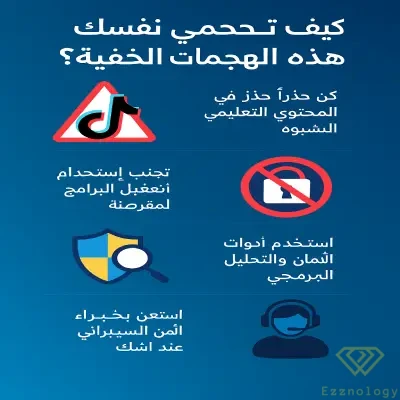
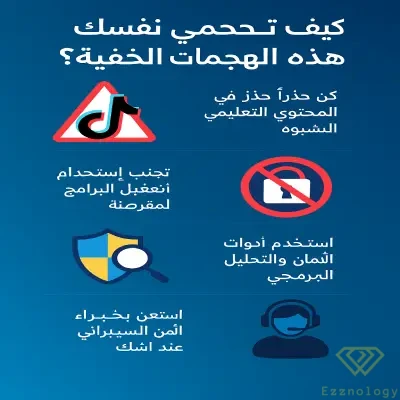
How Do You Protect Yourself from These Hidden Attacks?
Given the evolution of cyberattack methods, caution is no longer an option but a necessity. Here is a set of essential tips you can follow to protect yourself and your data from falling victim to this new type of deception:
🔐 Be wary of suspicious educational content: Don't be fooled by videos claiming to help you “activate” programs or get them for free, especially if they are not from trusted sources.
🚫 Avoid using or activating pirated software: These tutorials are often a direct means of spreading spyware or malware.
🛡 Use security and code analysis tools: There are many AI-powered tools that can analyze code commands and detect whether they are harmful before executing them.
📞 Consult cybersecurity experts when in doubt: If you notice unusual behavior on your device, seek technical help immediately.
🔄 Take response steps after a breach: If your device has been compromised, immediately remove the malware, change the passwords for all your accounts, and carefully monitor your bank and financial accounts.
The Future of Cybersecurity in the Age of AI
With the rise in the use of AI in carrying out cyberattacks, it has become essential for tech companies to keep pace with this change through innovative defensive measures.
-
🧠 Counter-AI: We may soon see a new wave of defensive AI tools capable of analyzing and understanding hidden threat patterns, even if they come in the form of visual or audio content.
-
🔍 Strengthening detection systems on social platforms: Platforms like TikTok and Instagram are expected to develop better capabilities to detect this type of attack, and perhaps prevent suspicious videos from being uploaded before they are published.
-
🌐 Pioneering experiments have already begun: Google, for example, has started rolling out a feature in the Chrome browser that allows automatically changing compromised passwords, a step aimed at protecting users from any security leak without their direct intervention.
Also
Between the evolution of attack methods and the complexity of defense mechanisms, digital awareness remains the first line of defense for users. A video that seems useful or educational may be a Trojan horse to steal your data!
Be smart, don't be fooled by appearances, and think twice before executing any instructions of “unknown origin”.