The Agile Methodology in Project Management
The Agile Methodology in Project Management
Agile is a methodology for managing projects — whether software or non-software — that focuses on building the product through multiple phases and short time periods. The core idea of Agile is to produce a functional product at each phase, carrying new features added over the previous phase. This sub-product resulting from each phase is considered a real product that the client can interact with. The goal is to bring the product closer to the client and measure their satisfaction throughout the product development phases.
The Agile methodology uses several approaches, including Scrum and Kanban, which are considered among the implementation methods of Agile.
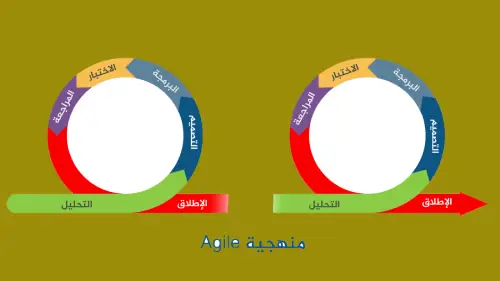
Agile represents a revolution in software project management, where traditional methods such as Waterfall were previously used for construction. In the traditional approach, projects proceed according to a specific sequence of steps including analysis, requirements gathering, design, development, testing, and maintenance.
The Agile Methodology
Achieving effective communication with the client and flexibly meeting their expectations
Traditional project management methods were unable to keep pace with the rapid evolution of software and fast-changing life demands, nor to meet aspirations for developing and changing project requirements. When relying on traditional methods, a project takes a long time to complete, resulting in high costs. In addition, the costs of redesigning, redeveloping, and making changes to accommodate evolving requirements are very high.
The Agile methodology is completely different from traditional approaches. Agile focuses on implementing specific features within a short time period and presenting them to the client. This allows the client to see how their idea was implemented, and we can observe their reaction when they see the product. If there are any modifications or changes required, we can implement them quickly and easily. We then move on to implementing the next feature until the project is fully built.
Generally, the client has an idea and an explanation of what they want from the software, but the details and features they desire are often vague until they actually see the final product. The client can evaluate whether the product meets their expectations based on their actual view of the product.
What Does the Agile Methodology Rely On
The Agile methodology relies on delivering real preliminary products to the client during successive time periods, where the client can try them out, evaluate them, and provide feedback or suggestions. These observations or suggestions can be easily modified at this early stage of the work. Consequently, it is possible to move forward with steady steps and achieve the next version of the product by adding more features and characteristics until the project is complete.
Through this approach, you have strong confidence that the initial product that will be used in subsequent phases is an effective, usable, and developable product that aligns with the client's aspirations and requirements.
This idea is very common in the field of entrepreneurship, where many entrepreneurs use it at the beginning of their startup projects. Building a Minimum Viable Product (MVP) is a fundamental part of the Lean Startup methodology. I recommend learning about this concept by attending a course on the “Alif Startup” platform.
The goal of testing and evaluating an MVP is to give clients the opportunity to see a real product as quickly as possible and obtain their Feedback. This is exactly what the Agile methodology believes in. Agile focuses on delivering real, measurable preliminary products rather than focusing on the final product.
Agile Values
Agile values are fundamental principles in agile software development, and the Agile methodology is considered suitable for effectively dealing with changes in software development projects. The four Agile values are as follows:
- Working software over comprehensive documentation:
This means that the focus should be on producing working software with certain basic features rather than writing comprehensive documentation of all details. This does not mean ignoring documentation altogether, but it is recommended to document only important things after confirming that the product is working correctly. - Individuals and interactions over processes and tools:
This means that the focus should be on team members and the interaction between them rather than on work tools and processes. Tools and processes are important, but they will not be effective without people who can use them correctly. - Customer collaboration over contract negotiation:
This means that the focus should be on collaborating and partnering with the client in building the product rather than on negotiating contracts. Contracts are often inflexible and difficult to modify, whereas continuous collaboration with the client can help better understand their requirements and meet their needs with greater precision and flexibility. - Responding to change over following a plan:
This means that the focus should be on responding to changes requested by the client rather than strictly following the defined plan. When presenting the product to the client, the focus should be on implementing the modifications and improvements requested by the client with high priority, as this approach can allow better and more flexible fulfillment of the client's needs.
Agile values revolve around delivering value to the client and continuous improvement, and encouraging collaboration and interaction among the people involved in the project. These values must be adopted in all aspects of the agile software development process, including planning, execution, evaluation, and continuous improvement. Since Agile is a flexible methodology, it can be adapted and modified according to project circumstances and client needs.
It is important to note that Agile is not merely a set of values; it is also a set of working methods and practices. The most well-known Agile approaches are Scrum and Kanban, and both approaches are based on the four values mentioned and provide a specific framework for implementing them.
Agile is considered an effective methodology for software development, as it allows adaptation to continuous changes and achieves value for the client more quickly. Agile aims to foster effective collaboration and interaction among team members and clients, and encourages innovation and continuous improvement.
Agile Principles
The Agile principles are a set of values and guiding principles upon which the Agile methodology relies in software development and project management. These principles include the following:
- Customer satisfaction: Achieving customer satisfaction by delivering effective and usable software, and committing to meeting specified delivery deadlines.
- Welcoming change: Receiving and accommodating changes in customer requirements, even in advanced stages of the development process.
- Regular delivery: Delivering usable software frequently and in the shortest time possible.
- Close collaboration: Encouraging programmers and the technical team to work together and communicate daily throughout the project period.
- Face-to-face conversations: Using direct communication and personal conversations between team members as the primary means of exchanging information (for example, short daily team meetings known as "Stand-up Meetings").
- Trust and empowerment: Building an environment that fosters trust and appreciates and empowers individuals, motivating them to achieve project success.
- Usable software: Providing software that works effectively and meets the client's needs, considered a key measure for evaluating progress.
- Continuous development: Encouraging investment in developing and improving individuals' skills and knowledge. Sponsors and developers should have the ability to maintain a pace of continuous improvement.
- Excellence and quality: Continuous attention to achieving excellence and quality in technical design and development.
- Simplicity: Reducing unnecessary work and focusing on the essential and important matters in the development process.
- Self-organizing teams: Building teams capable of organizing themselves and achieving the highest levels of performance and structural design.
- Continuous evaluation and improvement: Regularly measuring and monitoring team performance, correcting errors, and improving behavior.
The Agile methodology fundamentally relies on attention to individuals as one of the main success factors in projects.
Benefits of Using and Applying the Agile Methodology
The benefits of using the Agile methodology in project management are countless. This methodology helps teams manage projects more effectively, deliver high-quality products, and keep the budget within specified limits. Teams work as a harmonious unit responsive to changes in requirements effectively. The following highlights some important benefits of using the Agile methodology:
- Client confidence and risk reduction: The business owner participates in every phase of the project, which enhances collaboration between the team and the client. The team is able to better understand the client's vision and receive immediate feedback for adjustments. This increases the client's confidence in the team and makes them realize that the project is progressing quickly.
- Early delivery of an initial product: The project is divided into time phases, and a usable product is produced at each phase. This allows the client to launch their project early before the final versions are complete.
- Cost predictability: Thanks to defining a time period for each phase and specifying the defined tasks from the start, costs can be predicted to a large extent. This gives the client a better understanding of the costs they will incur at each phase until the project is finished.
- Allowing changes in requirements: The client can change requirements at the end of a phase or even at an advanced stage. This change is rescheduled in a new timeline.
- Focus on work value: The client participates in the project from the beginning, which helps the team understand the client's priorities and provide features of high value to them.
- Focus on users: Each phase produces an initial product that can be tested, improved, and modified based on feedback from actual users. This provides an opportunity to improve quality and better meet user requirements.
- Quality improvement: Work focuses on development, testing, and modification, which helps in continuous work completion and improving the quality of the final product. The product is regularly tested and modified based on continuous improvements.
The benefits achieved from using the Agile methodology may vary depending on the nature of the project and the team working on it. There must be full commitment from the team and clients to ensure full benefit from the potential advantages of this methodology.
It is also important that Agile be implemented correctly according to its core principles, including continuous communication and collaboration between the team and the client, dividing the project into manageable phases, and focusing on achieving value and meeting user needs.
In general, Agile is considered an effective methodology for managing projects that require flexibility and the ability to adapt to continuous changes. It helps achieve project goals effectively and improves product quality and client confidence.
What Are the Disadvantages of Agile
Certainly, as with any project management methodology, the Agile methodology has some disadvantages. Some of these disadvantages are outlined below:
- Unpredictability of cost and schedule: At the beginning of large projects, it is difficult for teams to accurately predict the time and cost required to complete the project, especially if the team is not well-versed in implementing Agile.
- Exhausting daily meetings: Agile requires holding daily meetings among team members, which can be exhausting and consume a significant amount of time and effort from team members.
- Inability of the business owner to be fully dedicated: The business owner may find it difficult to allocate sufficient time to attend the frequent meetings with the team, which may lead to appointing a representative for the client who follows up on progress and makes decisions at times, affecting communication and causing delays in the project.
- Lack of detailed documentation: Due to the focus on continuous delivery and personal interaction, there may be a lack of comprehensive project documentation, making it difficult for new team members to integrate easily into the project.
- Frequent changes in requirements: The focus on meeting the client's changing needs may lead to frequent changes in requirements, which can make it difficult to achieve stability and focus in achieving goals.
- Lack of clarity in the client's vision: The lack of clarity in the client's vision or their direct feedback on preliminary products may cause the team to focus on aspects that are unimportant or not required by the client.
Teams working with the Agile methodology, their clients, and especially the business owner and project client must be aware of the potential disadvantages and take the necessary steps to overcome them and maximize the benefits of Agile.
Methods of Applying the Agile Methodology
Applying the Agile methodology encompasses a set of approaches and methodologies. Here we will review some of the most common and widely used ones.
- Scrum:
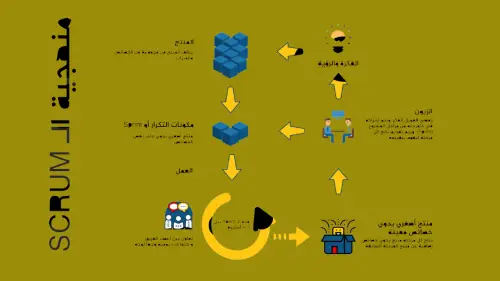
Scrum is considered one of the most well-known approaches used in implementing the Agile methodology. Scrum is used in software development and the design of complex products. The product is broken down into a set of elements (Product Backlog), and these elements are divided into smaller groups known as (Sprint Backlog). Work is done on each group within a specific time period called a (Sprint), which ranges between one week and 4 weeks. The Sprint is repeated sequentially with modifications and improvements over the previous Sprint until the final product is reached.
In Scrum, there are a set of Roles that include:
- Product Owner: The product owner is the person who has a comprehensive vision and knowledge of the product and how it should look.
- Scrum Master: Manages the Scrum process in general. They undertake several tasks such as upholding Scrum principles, facilitating meetings, collaborating with the product owner, removing obstacles, and continuous improvement.
- Team: Consists of team members who work together to accomplish the required tasks. Typically, the team consists of 5 to 9 people, and in the case of large projects, sub-teams can be formed.
In Scrum, the team commits to the specified time periods for producing the product, and no modifications are allowed during the Sprint. At the end of each Sprint, an actually usable product is presented, where the client can evaluate it and provide feedback. The next Sprint is then initiated by adding new features or modifying the current product according to the client's feedback.
- Kanban:
Kanban is considered one of the visual management systems used in Agile. The Kanban system relies on a board that displays work as a Flow of tasks and different stages. Tasks in the workflow are clearly defined, and tasks move from one stage to the next based on the team's capacity and resource availability. Kanban aims to achieve smooth workflow and reduce stops and blockages. - Extreme Programming (XP):
Extreme Programming (XP) is considered one of the most well-known patterns in Agile and is used for software development. XP focuses on quality, collaboration, and continuous improvement. XP includes a set of practices such as continuous planning, simple design, automated testing, and continuous integration. The focus is on providing usable products in a short time and with high quality. - Lean Software Development:
The Lean Software Development methodology is based on the Lean philosophy that aims to achieve maximum value for the client with the least amount of waste. This methodology focuses on improving workflow, reducing waste, and achieving quality. It includes a set of concepts such as identifying value for the client, determining the speed of workflow, delivering the product early, and empowering teams to make informed decisions.
These are some of the common methodologies in applying Agile. The appropriate methodology can be chosen according to the nature of the project and the needs of the team and client.
The technology used in the Kanban method relies on visual planning to track project progress and distribute tasks among the team. Tasks are represented on cards on the board, and these cards move through columns representing the stages of project execution, such as "In Progress," "Under Review," and "Completed."
The Kanban method is distinguished by its flexibility and ability to handle changes effectively. Adjustments and improvements can be made at any time without the need to wait for a specific time period to end, as is the case with Scrum. The system allows for prioritization and determining workflow based on team capacity and available resources.
With a small number of tasks required to be completed at the present time, the team can focus better on those tasks and execute them with high quality. Completed products are delivered gradually rather than waiting for the entire project to finish.
Kanban is considered a suitable option for teams working in an environment that requires facing continuous changes and dealing with shifting priorities. It can be used in various fields and for managing diverse projects effectively.
And with that, dear friends, we have successfully completed the mission ✌
Don't forget your brothers and sisters in Palestine in your prayers
With greetings from the #Ezznology team
Find what interests you at 👈#our store
You can also become a member of our family by joining the Telegram group from 👈here
Or the Facebook group from 👈here
To subscribe to our newsletter on Google News, click here✌👇

Or scan the code