What is a Denial of Service or DDoS Attack?
What is a Distributed Denial of Service (DDoS) Attack?
Distributed Denial of Service (DDoS) attacks are among the most prominent threats in the field of internet security today, due to their ability to disrupt digital services and directly impact business continuity. This type of attack relies on flooding servers or networks or applications with a massive volume of fake requests, which leads to the exhaustion of their resources and prevents real users from accessing the service.
DDoS attacks typically operate through a large network of compromised devices, known as a Botnet, which are remotely controlled to send simultaneous requests to the target at the same time. As the number of these requests increases, the systems become unable to respond normally, leading to severe slowdowns or a complete service outage.
The impact of DDoS attacks is not limited to temporary website downtime; they can also cause financial losses, reputational damage, and a decline in customer trust, especially in organizations that rely primarily on digital services.
To counter this type of attack, organizations rely on a range of security solutions, such as intrusion detection and prevention systems, cloud protection services, load balancing, and traffic analysis to detect abnormal patterns early. Combining these measures helps reduce the impact of attacks and ensures service continuity even in the face of growing threats.
A Distributed Denial of Service (DDoS) attack is defined as a malicious attempt to disrupt normal traffic to a targeted server, service, or network by overwhelming the target — or its surrounding infrastructure — with massive amounts of internet traffic in a short period of time.
The danger of DDoS attacks lies in their reliance on a large number of compromised systems as simultaneous attack sources, making detection and mitigation far more complex. These systems include traditional computers as well as network-connected resources such as Internet of Things (IoT) devices, which are often less protected and easier to exploit.
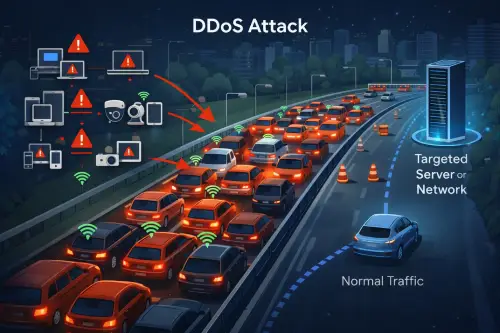
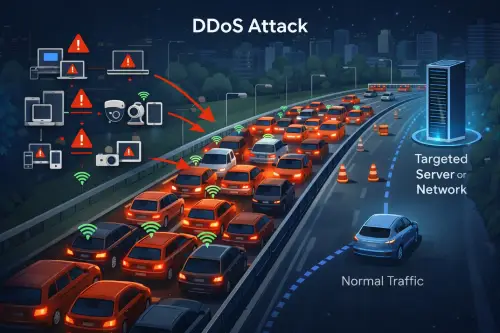
In simple terms, a DDoS attack can be compared to a sudden traffic jam that completely paralyzes a highway, where vehicles pile up abnormally, preventing normal traffic from reaching its destination. Similarly, the volume of fake requests in a DDoS attack prevents real users from accessing the targeted service, even though the system is technically intact.
The image depicts a DDoS attack in the form of a congested highway:
-
The red cars represent malicious traffic coming from compromised devices (computers, phones, IoT devices).
-
The blue car symbolizes legitimate traffic trying to reach the server.
-
The targeted server appears at the end of the road surrounded by congestion, indicating service disruption.
-
The arrows and alerts illustrate the flow of the attack from multiple sources, making it easy to understand even for non-specialists.
How Does a Distributed Denial of Service (DDoS) Attack Work?
DDoS attacks are typically executed through massive networks of internet-connected devices. These devices are not limited to computers alone; they also include smartphones, servers, and Internet of Things (IoT) devices such as smart cameras and routers.
In this scenario, these devices are first compromised using malicious software, allowing the attacker to control them remotely without their owners' knowledge. Compromised devices are known as Bots or Zombies, while the network that combines them is called a Botnet.
Once the Botnet is formed, the attacker becomes capable of launching the attack by sending unified commands to all compromised devices simultaneously. When targeting a specific server or network, all these devices send synchronized requests to the target's IP address.
This enormous flood of requests leads to the exhaustion of the server's or network's resources (such as the processor, memory, and bandwidth), causing severe slowdowns or a complete service outage, ultimately denying real users access to it.
The danger of DDoS attacks lies in the fact that every device participating in the attack is a real device connected to the internet, making it difficult to distinguish between normal traffic and malicious traffic, which complicates the process of countering or isolating the attack quickly.
In this manner, ordinary devices spread around the world are transformed into a digital pressure tool capable of disrupting major websites and services within minutes, which makes DDoS attacks one of the most common and dangerous cyber threats today.
How Can a Distributed Denial of Service (DDoS) Attack Be Detected?
A sudden slowdown or complete outage of a website or digital service is one of the most obvious indicators of a DDoS attack. However, this symptom alone is not sufficient for certainty, as similar problems may arise from natural causes, such as a sudden and legitimate surge in visitor numbers.
Therefore, confirming the existence of a DDoS attack requires a deeper analysis of network traffic. Traffic analysis and network monitoring tools help detect a range of warning signs, the most notable of which include:
-
An abnormal volume of traffic originating from a single IP address or a specific range of addresses.
-
A dense flow of requests from users sharing a common pattern, such as device type, geographic location, or browser version.
-
A sudden and unexplained increase in the number of requests directed at a single page or a specific Endpoint.
-
Unusual traffic patterns, such as sharp spikes at illogical times of day, or a recurring surge following a regular automated pattern (such as a notable increase every 10 minutes).
In addition to these general indicators, there are more subtle signs that may vary depending on the type of DDoS attack used, whether it targets the network layer, the server, or the application itself. For this reason, detecting these attacks typically relies on combining continuous monitoring, intelligent data analysis, and technical expertise in interpreting traffic behavior.
What Are the Main Types of Distributed Denial of Service (DDoS) Attacks?
DDoS attacks vary depending on the parts of a network connection they target, as not all of them attack the system in the same way. To understand how these attacks work and their different types, it is first necessary to understand how a network connection is established over the internet.
A network connection is made up of several components known as Layers, where each layer performs a specific function within the communication process. This can be compared to building a house; work starts from the foundation, and layers are stacked one on top of the other, with each layer playing an essential role in the stability of the overall structure.
In this context, the OSI model is used as a theoretical framework that explains how data travels across networks. This model divides the communication process into seven independent layers, starting from the physical layer responsible for signal transmission, all the way up to the application layer that the user interacts with directly.
DDoS attacks target different layers of this model; some focus on exhausting network resources and infrastructure, while others seek to flood servers or disable the applications themselves. For this reason, the impact of each attack differs, and so do the methods of detecting and countering it depending on the layer being targeted.
Understanding these layers is a fundamental step for classifying common DDoS attacks, analyzing the nature of the threat, and selecting the appropriate protection mechanisms for each type.
Application Layer Attacks
Attack Objective:
This type is sometimes referred to as Layer 7 DDoS attacks, named after the seventh layer in the OSI model. The primary goal of these attacks is to exhaust the targeted server's resources to the point where it can no longer provide service to legitimate users.
These attacks focus on the layer responsible for generating web pages and processing HTTP requests. Although sending a single HTTP request is a simple and inexpensive operation from the user's side, responding to it can be taxing on the server; as it typically requires loading several files, executing database queries, and processing application logic to generate the requested page.
The danger of Layer 7 attacks lies in the fact that they mimic the behavior of real users, making it extremely difficult to distinguish malicious traffic from legitimate requests. For this reason, these attacks are considered among the most complex types of DDoS attacks to detect and defend against, especially when targeting websites or applications that rely on intensive dynamic operations in the background.
Due to their reliance on requests that appear normal on the surface, countering application layer attacks requires advanced solutions capable of analyzing behavior and understanding usage patterns, rather than simply measuring the volume of data traffic.
HTTP Flood Attack
This type of attack is similar to a massive number of users repeatedly pressing the page Refresh button continuously and simultaneously, but through thousands or millions of devices at once. The result is a dense flood of HTTP requests that overwhelms the server and ultimately leads to service disruption and denial of access.
HTTP Flood attacks vary in complexity:
-
Simple versions of the attack target a single URL using a limited range of IP addresses, with similar data such as the Referrer and User Agent.
-
Advanced versions use massive numbers of different IP addresses, target random URLs, and continuously change the Referrer and User Agent data, in order to mimic real user behavior and make the attack harder to detect.
Due to this variety and flexibility, HTTP Flood attacks are among the most effective Layer 7 attacks, especially against dynamic websites and applications that rely on databases.
Protocol Attacks
Attack Objective:
Protocol attacks are also known as State-Exhaustion Attacks, and they aim to disrupt services by exhausting the resources of servers or network equipment such as Firewalls and Load Balancers.
These attacks rely on exploiting vulnerabilities or weaknesses in Layer 3 and Layer 4 of the protocol stack, which are the two layers responsible for data transmission, routing, and session management.
By sending massive amounts of packets or incomplete connection requests, these attacks cause network resources to become exhausted, rendering the targeted system unable to process legitimate connections, resulting in a service interruption or severe degradation.
The danger of protocol attacks lies in the fact that they target the infrastructure itself, not just the applications, making their impact wide-ranging and potentially extending to affect multiple services simultaneously.
SYN Flood Attack
A SYN Flood attack can be compared to a warehouse worker who receives consecutive requests from a store front. Every time a request arrives, the worker goes to fetch the package and then waits for a confirmation before delivering it. As requests continue to arrive without any confirmation, the packages pile up until the worker can no longer carry any more, causing them to stop fulfilling new requests.
Technically, this attack exploits the mechanism of the TCP Three-Way Handshake, which are the steps that initiate any network connection between two devices. The attacker sends a massive number of SYN packets (connection initiation requests) to the targeted device, using spoofed IP addresses.
The server responds to each request by waiting for the final step of the handshake, which never occurs. As incomplete connections accumulate, the server's resources become exhausted, rendering it unable to process new legitimate connections, and thereby causing a denial of service.
Volumetric Attacks
Attack Objective:
Volumetric attacks aim to create a bottleneck in the network by consuming the entire available bandwidth between the target and the internet.
In this type of attack, massive amounts of data are sent to the targeted server, often using Amplification techniques or by generating heavy traffic through large-scale Botnet networks.
The danger of volumetric attacks lies in the fact that they do not only target the server but paralyze the connection itself, making the website or service inaccessible even if the internal servers are functioning properly. Countering this type of attack typically requires advanced protection solutions at the network level and from internet service providers themselves.
DNS Amplification Attack
A DNS Amplification attack can be compared to someone calling a restaurant and ordering "one of everything," then asking the restaurant to call back and recite the entire order, while the callback number actually belongs to the victim. In this way, a long, large response is generated and sent to the victim with minimal effort from the attacker.
Technically, the attack relies on sending small requests to open DNS servers using a spoofed IP address belonging to the victim. As a result, the DNS servers send large responses directly to the victim's address, leading to the consumption of bandwidth and flooding the network with unwanted traffic.
What Is the DDoS Mitigation Process?
The core challenge in dealing with DDoS attacks is distinguishing between malicious traffic and legitimate traffic. In some cases, a website may experience a massive surge in visits due to a legitimate event, such as a new product launch, and cutting off access in that situation would be the wrong decision.
On the other hand, if the sudden spike in traffic is coming from sources known for attacking, intervention becomes a necessity. The real difficulty lies in accurately separating real users from attack traffic.
In the modern internet, DDoS attacks take many forms, ranging from simple single-source attacks all the way to complex and adaptive attacks known as Multi-vector DDoS attacks.
Multi-vector DDoS Attacks
These attacks rely on using more than one method simultaneously to confuse defensive systems and exhaust the target's resources from multiple directions. They may target different layers of the protocol stack at the same time.
An example of this is combining a DNS Amplification attack that targets Layers 3 and 4, with an HTTP Flood attack that targets Layer 7. Countering this type of attack requires a diverse set of defensive strategies rather than a single solution.
In general, the more complex the attack, the harder it becomes to separate malicious traffic from normal traffic, as the attacker seeks to blend in as much as possible within normal traffic flow to weaken the effectiveness of protective measures.
Mitigation attempts that rely on randomly blocking or rate-limiting traffic are ineffective solutions, as they may block real users along with the attackers, and the attack may quickly adapt to bypass the measures taken. For this reason, multi-layered solutions are the most effective option for countering complex attacks.
Blackhole Routing
Blackhole Routing is one of the solutions available to most network administrators, where a special route is created to which traffic is directed and then completely dropped.
In its simplest form, and when applied without precise criteria, all traffic — whether legitimate or malicious — is directed to a dummy route (blackhole) where the data is dropped and not forwarded through the network.
In cases of severe DDoS attacks, the Internet Service Provider (ISP) may resort to routing all traffic for a specific website into this "blackhole" as a rapid defensive measure. Despite its effectiveness in protecting the rest of the network, it is considered a non-ideal solution, as it achieves the attacker's primary goal, which is making the service completely unavailable to users.
Rate Limiting
One of the methods for mitigating denial of service attacks is limiting the number of requests a server accepts within a specified time period. This method helps reduce automated web scraping attempts and brute force login attacks.
However, on its own, it is often insufficient to handle complex DDoS attacks. Nevertheless, it remains an important component within a comprehensive attack mitigation strategy, especially when combined with other tools for monitoring and classifying traffic.
Web Application Firewall (WAF)
A Web Application Firewall can help counter DDoS attacks targeting Layer 7. By placing a WAF between the internet and the targeted server, it can act as a Reverse Proxy that protects the server from specific types of harmful traffic.
A WAF relies on a set of rules to identify and block attack tools, and also allows the rapid implementation of custom rules when a sudden attack is detected, making it an effective tool for repelling complex attacks.
Anycast Network Diffusion
Another method for mitigating DDoS attacks is using an Anycast network to distribute attack traffic across a group of geographically distributed servers, so that the volume of malicious traffic is gradually absorbed.
This approach can be compared to redirecting a flowing river through several smaller channels, reducing the impact of the attack and making it more manageable. The effectiveness of this approach depends on the size of the attack and the efficiency of the distributed network, and it is considered an important part of Cloudflare's protection strategies against large and complex DDoS attacks.
A Simple Conclusion on DDoS Attacks and Protection Methods
DDoS attacks represent a major threat to any website or service on the internet, as they rely on overwhelming the server or network with massive traffic, leading to service outages or noticeably degraded performance. These attacks range from targeting the application layer, such as HTTP Flood, to targeting core protocols, such as SYN Flood or DNS Amplification, and sometimes more than one type is combined in a Multi-vector DDoS attack.
Despite their danger, there are effective tools and strategies to counter them, such as:
-
Rate Limiting to control the number of incoming requests per server.
-
Web Application Firewall (WAF) to block application layer attacks in an intelligent and rapid manner.
-
Anycast Network Diffusion to distribute the load and reduce the impact of the attack.
-
Blackhole Routing as a last resort to block malicious traffic entirely.
In summary, countering DDoS attacks requires a multi-layered strategy that combines advanced technical tools with careful traffic monitoring, while preserving the normal user experience. With a solid understanding of the types of attacks and their methods, companies can protect their networks and services more securely and effectively, ensuring uninterrupted service continuity.
And here, dear brothers and sisters, we have successfully completed the mission.
Send blessings upon the beloved Prophet, and your hearts will be at ease. Do good no matter how small.
And do not forget our brothers and sisters everywhere in your prayers.
Greetings from the team at #Ezznology #Ezz_Technology
You can also browse our store's products from here #our store or here
To join our family on the Telegram group click here
Also our Facebook group where we share information and help members, click here


Other topics that may interest you:
Western Union address in Alexandria
Best ways to improve sleep and mental health in 2026
How to protect your accounts from hacking?
Symptoms of vitamin D deficiency
The importance of cybersecurity in 2026