Google Beam for a New Kind of 3D Communication
Google Unveils “Beam”… A Revolutionary AI-Powered 3D Visual Communication Platform
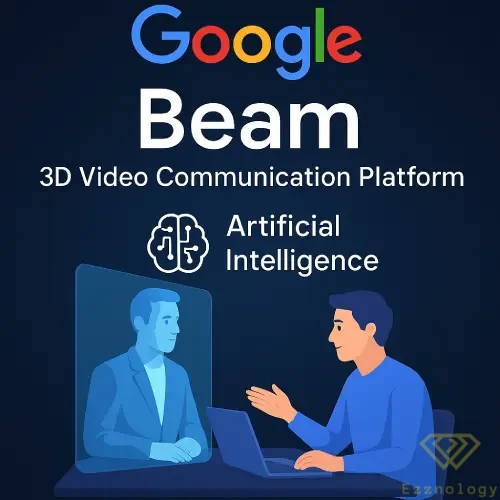
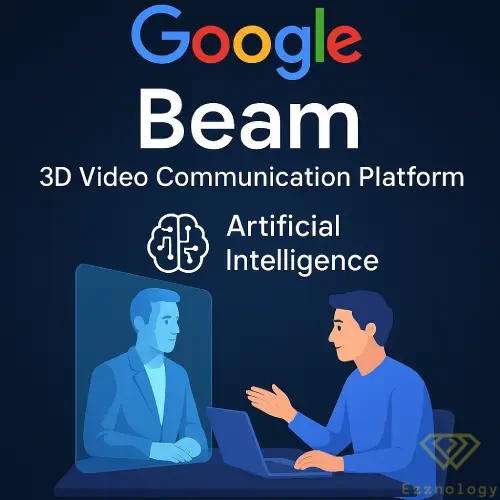
Google has officially announced the launch of Google Beam, the new platform designed specifically to enhance the 3D visual communication experience in the business sector. The platform relies on AI technologies to bridge distances and achieve realistic interaction that simulates face-to-face meetings.
Beam represents the natural evolution of the Project Starline initiative, a research project Google first unveiled in 2021, aiming to redefine video calls through advanced imaging technologies that give the user a sense of real presence without the need for glasses or virtual reality headsets.
The platform relies on an AI-powered Volumetric Video model, which converts two-dimensional videos into three-dimensional displays in real time, giving users an immersive interactive experience.
Beam uses Light Field Display technology to enhance the sense of actual presence, enabling natural visual communication and the reading of subtle non-verbal cues – such as facial expressions and eye movements – thereby enhancing the quality of interaction and trust between parties, as if they were in a real meeting inside the same room.
The platform runs on the Google Cloud infrastructure, and integrates seamlessly with the AI solutions developed by the company, providing high performance, communication stability, and compatibility with established work environments. It has been designed to be scalable to fit the needs of companies of all sizes, with support for a high level of security and connection quality.
Google Beam is scheduled to become available later this year, with HP set to begin providing the first devices supporting the platform, as part of a strategic partnership to market the new technology globally.
In parallel with the launch, Google revealed a real-time voice translation feature within the platform, through the integration of Google Meet, to provide accurate instant translations of conversations while preserving the original voice tone, which enhances the ability of multinational teams to communicate effectively and smoothly across borders.
🚀 Google Beam: A New Revolution in Human Communication Through AI
In a new step confirming Google's leadership in the smart communication technologies sector, the company officially announced the launch of Google Beam, a 3D visual communication platform targeting the business sector, relying on an advanced blend of artificial intelligence and volumetric imaging technologies aimed at creating an interactive experience that simulates real-life meetings to an unprecedented degree.
Beam is not merely an upgrade of traditional video calls; it represents a qualitative leap in the way humans communicate remotely, by creating “realistic windows” between parties using instant 3D images, without the need for any additional equipment such as virtual or augmented reality glasses.
💡 The Technical Background: From a Research Project to a Commercial Product
Beam represents the practical extension of Project Starline, which Google first announced in 2021 as an ambitious research initiative aiming to redefine the concept of digital meetings. During the years of development, Google focused on addressing one of the biggest challenges of virtual communication: the absence of a sense of real presence.
Through Beam, the company was able to deliver a solution based on:
-
Volumetric Video: where two-dimensional video is captured and converted into a live three-dimensional display in real time.
-
Light Field Display technology: which reconstructs depth and fine details to give the user the feeling of standing in front of a real person.
🎯 Beam's Practical Advantages
-
👁️ Natural eye contact: allows seeing subtle facial expressions and gaze direction.
-
🤝 Enhanced non-verbal interaction: such as gestures and body language, which improves the quality of understanding.
-
🔐 High-level security: built on the Google Cloud infrastructure, with comprehensive support for security protocols.
-
🔄 Smart integration: with Google Workspace and Google Meet tools.
-
⚙️ Flexible scalability: it can be applied in small, medium, and large enterprise environments.
🧠 Artificial Intelligence Is Strongly Present
The reliance on AI in Beam was not just technical support, but a fundamental element in:
-
Improving video quality and volumetric imaging in real time.
-
Audio processing and speech tone enhancement to reduce noise and provide complete clarity.
-
Real-time multilingual translation with high accuracy while preserving the original voice tone, a strategic feature for multinational companies.
🤝 Partnership with HP… Devices Coming Soon
HP is scheduled to begin offering the first devices supporting Beam later this year, as part of a strategic partnership with Google aimed at marketing the innovative solutions in global business environments. These devices are expected to be equipped with advanced cameras and sensors that enable high-resolution volumetric imaging without setup complexity.
🌐 The Expected Impact on Work Environments
Beam is a decisive step in the future of Hybrid Work, as it provides a convincing alternative to travel and in-person meetings, while preserving the quality of human interaction. It may also serve as a foundation for building more realistic virtual communication spaces in education, healthcare, training, and even e-commerce in the future.
📅 Availability
Google Beam is expected to be officially available during the second half of 2025, with companies wishing to adopt the technology able to pre-register through Google's authorized partners.