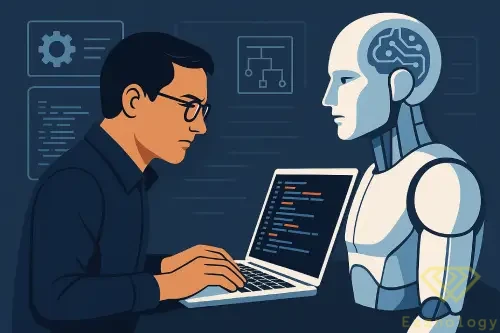
Is Artificial Intelligence Stealing the Future of Programmers?
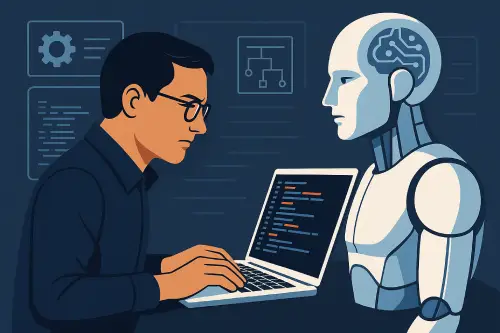
Is Artificial Intelligence Stealing the Future of Programmers?
Artificial Intelligence Invades the World of Programming: Has the Time for Radical Change Come?
A number of experts believe that artificial intelligence is on the verge of bringing about a radical transformation in the field of programming, having come close to the ability to carry out the core tasks that software engineers perform on a daily basis.
At a recent conference organized by Goldman Sachs, Sarah Friar, Chief Financial Officer of OpenAI, revealed a new direction in the use of artificial intelligence under the name A-SWE, an abbreviation for "Agentic Software Engineer." Friar indicated that this agent does not only aim to enhance engineers' performance, but goes beyond that to act as a fully integrated software engineer capable of building applications from scratch.
Friar added:
"What sets A-SWE apart is that it does not limit itself to software development, but also handles tasks that developers typically avoid, such as conducting quality tests, tracking and fixing bugs, as well as documenting code with precision. This is what makes it an effective tool capable of significantly multiplying the productivity of programming teams."
This shift opens the door to fundamental questions about the future of traditional programming, and the role of engineers amid the growing reliance on AI agents in complex technical operations.
Should Developers Be Worried?
With the accelerating pace of development of AI tools such as A-SWE, the question poses itself forcefully: Should developers and software engineers worry about their professional future?
Opinions on this matter are divided. Some believe that artificial intelligence represents a clear threat, while others see it as an opportunity to redefine the role of the software engineer.
For his part, Andy Thurai, tech expert and former advisor at Constellation Research and IBM Watson, told ZDNET:
"Those working in the programming field should be worried. The field will see fierce competition, and only those who can adapt and deliver real value will survive… As for the rest, they will be pushed out."
Agreeing with him is Lori Schafer, CEO of Digital Wave, pointing out that generative AI is no longer limited to supporting developers, but is moving toward reshaping the very core of the software development process itself.
She explains:
"Over the next five years, programming teams will transition from being responsible for writing code to becoming small strategic teams that guide AI systems to produce code intelligently and efficiently."
Nevertheless, this change does not mean the end of the programming profession, but rather a profound shift in the nature of roles and responsibilities. Schafer adds:
"Thanks to AI agents, we will see a reduction in error rates, improved performance, and accelerated production. Instead of writing code from scratch, developers' roles will focus on editing, reviewing, and quality-checking AI output."
Survival for Those Who Master the Use of AI Agents
Andy Thurai points out that the threat of job loss will not affect all programmers, but will target those who fail to keep up with the shift and acquire the skills to use AI tools.
In his view, the rapid evolution in this field will reduce the need for large numbers of developers, illustrating the point with a simple example:
"When one person can build a complete application in a single day using an AI agent, and another needs four weeks to do it manually, it stands to reason that priority goes to the first."
The message here is clear: future distinction does not depend solely on writing code, but on who knows how to use artificial intelligence to create greater value in less time.
More Balanced Perspectives
On the other side, some experts believe that talk of fully replacing software developers remains far from reality, and that artificial intelligence, at least for now, will augment human skills rather than eliminate them.
Neil Sahota, CEO of ACSILab, says:
"It is true that A-SWE represents a major leap in AI capabilities, but claiming that it can fully replace software engineers is an exaggeration."
He adds:
"AI may master writing code, but it does not understand the context or the purpose behind it. It only simulates logic, without possessing the ability to grasp the fine details or see the full picture."
Cassie Kozyrkov, CEO of Kozyr, also affirms that AI will not sideline humans from the picture, especially in sensitive sectors such as cybersecurity, finance, and healthcare, where matters require precise decisions and deep contextual knowledge that machines cannot easily replicate.
The Future of the Human Role in Programming
Amid this rapidly accelerating shift driven by AI tools, profound questions arise about the shape of the human role in the world of programming in the future.
In this context, Cassie Kozyrkov clarifies that programmers will not be replaced entirely, but their roles and responsibilities will be radically redefined.
She says:
"AI agents will not eliminate the programmer's role, but will transition it from manual writing to reviewing, analyzing, and interpreting. However, this shift is not necessarily desirable or preferred by everyone."
Kozyrkov adds a vision of a new reality that programmers may face:
"Some may find themselves in a role closer to that of archaeologists; digging through code written by AI, searching for errors and problems. Many developers will tell you that writing code themselves is more creative and enjoyable than inspecting code they did not write."
She also points out that this new role will not be free of challenges, and may require additional responsibilities including:
-
Monitoring the performance of AI agents
-
Correcting errors produced by them
-
Handling edge cases and exceptions
-
Maintaining and continuously updating systems
-
Bearing full responsibility when failures occur