IT Problem Management | IT problem management

First, my friend, let us get acquainted with:
What is IT Problem Management:
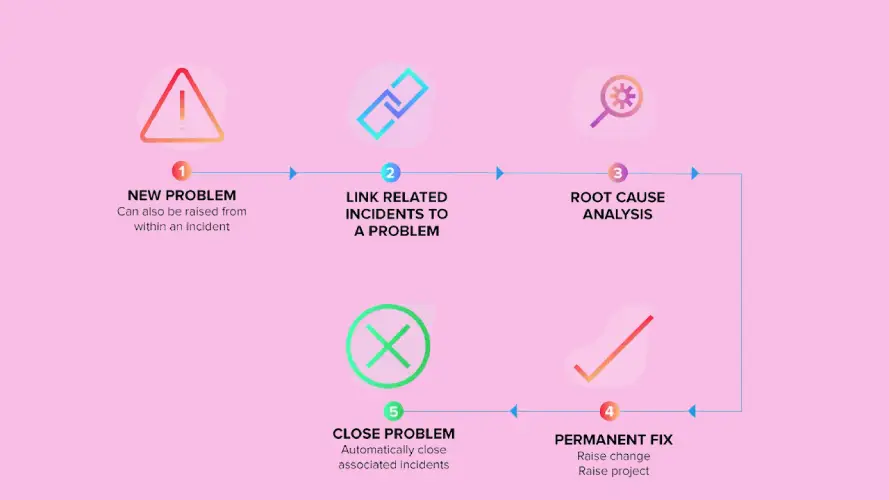
IT Problem Management is a systematic process for identifying and resolving underlying problems within the IT infrastructure. A problem is the real or potential cause of multiple incidents. These problems may arise from major incidents affecting many users, or from recurring incidents. Problems can also be detected in infrastructure diagnostic systems before they affect users.
Also:
Incidents hinder business productivity, so providing quick solutions helps ensure business continuity. However, when multiple incidents occur simultaneously or the same incident recurs multiple times, it is not sufficient to simply provide ad-hoc solutions or repeat the same fixes.
IT Problem Management aims to ensure a minimum number of incidents by delving deeply into incidents to reach root causes and permanent fixes, and also to reduce the severity of incidents through proper documentation of existing problems and providing workaround solutions.
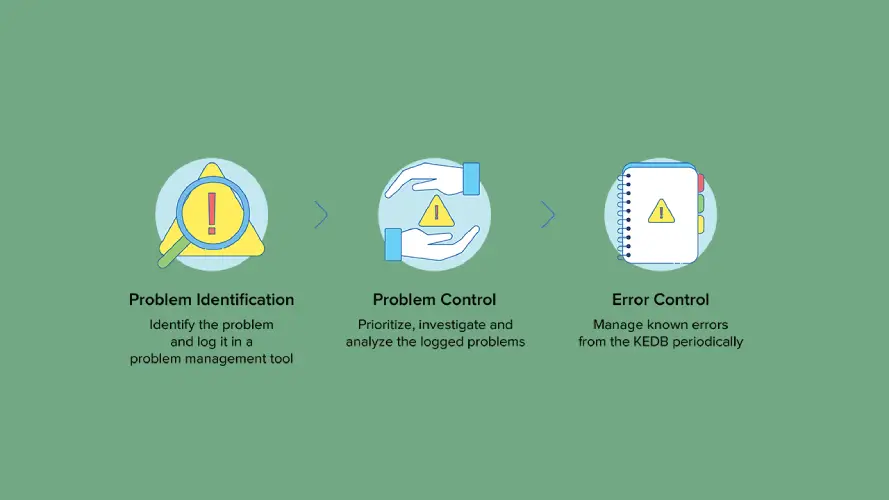
There are three main phases in IT Problem Management
- Problem identification
- Problem control
- Error control
The ultimate goal of IT Problem Management is to reduce the impact of incidents and eliminate recurring incidents by addressing root-cause problems.
Problem management differs from incident management in two key ways. First, incident management deals with issues that are currently affecting users, while problem management focuses on issues likely to appear in the future. Second, effective problem management practice significantly reduces the volume of incident tickets, saving time and effort for IT support staff. This leads to other benefits such as reducing the average time to repair, increasing customer satisfaction, improving the known error knowledge base, and lowering IT support costs. Furthermore, proactive problem management helps the organization discover and eliminate problems before they affect business operations. Problem management is an effective ITSM practice when used alongside other ITSM practices such as incident management, change management, knowledge management, and continual improvement.
Workaround:
- Temporary solutions that restore services and ensure business continuity.
- A workaround is a temporary solution that can be quickly applied to reduce the impact of a problem or incident.
- Its purpose is to restore services as quickly as possible, until a permanent solution to the problem is found.
Root cause analysis (RCA):
- Investigation techniques that help discover the underlying cause of a problem.
- The goal of RCA is to understand what caused the problem to occur, not merely to treat the symptoms.
- RCA helps prevent the problem from recurring in the future by addressing the root cause.
Known error:
- Problems that have occurred before and have a known workaround or known root causes.
- Known errors and their solutions are documented to avoid rediscovering them.
- The known error database can be referenced to quickly find the appropriate solution.
Known error database (KEDB):
- A database created by documenting known errors and their solutions.
- The KEDB helps reference previous solutions for familiar problems.
- The goal is to speed up the problem-solving process and avoid recurrence.