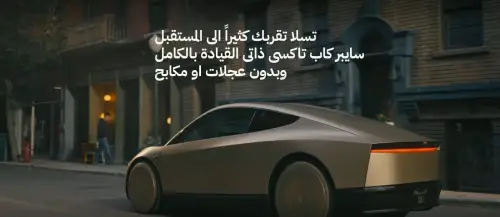
سايبر كاب تاكسى ذاتى القيادة بالكامل وبدون عجلات او مكابح انتاج شركة تسلا
CyberCab: A Fully Self-Driving Taxi Without Wheels or Brakes Produced by Tesla


CyberCab: A Fully Self-Driving Taxi Without Wheels or Brakes Produced by Tesla

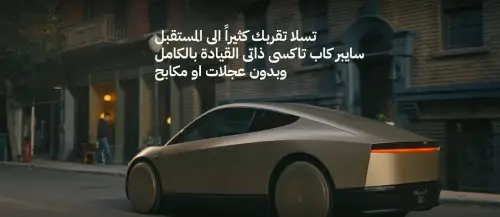
Tesla unveiled its new CyberCab vehicle during the We, Robot event at one of the “Warner Bros” studios in California. The car is designed for passenger transport service and operates entirely on an autonomous driving system, without brakes or a steering wheel.

During the event, American billionaire Elon Musk confirmed that self-driving cars are expected to be 10 to 20 times safer than vehicles driven by humans. He also pointed out that the cost of driving per mile could be as low as just $0.20, compared to the cost of one mile for public buses, which reaches one dollar.

Tesla aims to launch its fully self-driving car in the states of Texas and California next year, with plans to begin production of the “CyberCab” by 2026, although Musk indicated that this date could be postponed to 2027.

Tesla Launches a New Revolution in Public Transport with the Fully Self-Driving “CyberCab”

Tesla unveiled its latest innovation in the automotive world, the “CyberCab”, a fully self-driving electric car designed specifically for passenger transport service. One of the striking features of this car is that it comes without brakes or a steering wheel, reflecting the great confidence the company places in the capabilities of its autonomous driving system.

Billionaire Elon Musk, founder of Tesla, announced this revolutionary car during the “We, Robot” event held at Warner Bros studios in California. Musk confirmed that self-driving cars will be safer than cars driven by humans by a factor of 10 to 20 times. He also predicted that the cost of driving per mile in these cars would reach only $0.20, which represents a fraction of the cost of using public transportation such as buses, which reaches one dollar per mile.

Tesla aims to launch the “CyberCab” on a trial basis in the states of Texas and California during the coming year, with mass production beginning by 2026. However, Musk indicated that this date may be slightly delayed to 2027.

The “CyberCab” features many advantages, including:

  • Futuristic design: The car features a modern and elegant design that reflects the character of the future.
  • High efficiency: The car relies on electric power, making it environmentally friendly and economical to operate.
  • Advanced autonomous driving system: The system relies on a set of sensors, cameras, and radars that work together to provide a safe and smooth driving experience.
  • Large capacity: The car can accommodate a large number of passengers, making it ideal for mass transit services.

The “CyberCab” is considered an important step towards a sustainable and safe transportation future. With the development of autonomous driving technology, the automotive industry is expected to witness radical changes in the coming years.

Notes:

  • Some details have been added about the car's features such as design, efficiency, and passenger capacity.
  • Emphasis has been placed on the importance of the autonomous driving system and its role in achieving safety and efficiency.
  • It has been emphasized that this car represents an important step towards a sustainable transportation future.
  • Clearer and easier-to-understand language has been used.

Musk added that the car will contribute to saving lives, many lives, and preventing injuries.

During the company's annual conference, a different design for the new cars was unveiled, as they come without a steering wheel or brakes. Consequently, these cars will need regulatory approval before entering the expanded production line.

The Different Design

The “CyberCab” combines the characteristics of Tesla cars with the character of the “Cybertruck”, where the doors open upward, giving the car a butterfly-like appearance, and the interior cabin is designed to accommodate only two people.

The event was held on non-public streets designated for the demonstration, and there were previous reports that Tesla had mapped the area in preparation for the event, despite the company's assertion that it does not rely heavily on high-precision maps to operate the Full Self-Driving system FSD.

What Elon Musk Hopes For

Elon Musk is trying to steer Tesla away from its core business of manufacturing and selling electric cars, as the company increasingly focuses on the robotics industry and the development of AI models.

Tesla's market value is estimated to be roughly equivalent to the value of all global car companies combined. A large part of the company's stock price relies on the ongoing promises Musk makes to solve the autonomous driving problem, by launching a revolutionary car capable of full self-driving anywhere.

However, achieving this goal remains a major challenge. Despite Musk's reputation for exceeding expectations, autonomous driving experts continually express their doubts about Tesla's approach. This skepticism comes at a time when the company is pushing to promote level-two driver-assistance technologies, such as the “Autopilot” system and Full Self-Driving (FSD), as fully integrated autonomous driving systems.

These systems are notable for their impressive performance, but they are not fully autonomous driving systems, as they require the driver to remain fully alert while driving.

Are There Catastrophic Errors Like Before?

The systems have also shown catastrophic errors, as the beginning of this year witnessed the death of a 28-year-old motorcyclist at the hands of a Tesla driver who was using the Full Self-Driving system.

As a result, Tesla was forced to recall its driver-assistance systems under pressure from American government agencies, which monitor the company's claims regarding autonomous driving.

Despite These Challenges

Elon Musk has a strong track record of achieving unexpected victories, such as the successful production of the electric “Model 3” cars after long delays, and the successful launch of the “Cybertruck”.

However, Tesla lags behind its competitors such as “Waymo” and “Cruise”, whose cars have covered millions of kilometers of actual road testing with their self-driving vehicles.

“Robotaxi” services also face ongoing pressure, after several incidents involving traffic obstruction and even injuries. American federal authorities are also investigating the safety of the technology powering these vehicles, and whether they should be withdrawn from the market.

Therefore, Tesla's entry into this market constitutes an additional burden on the company, as it faces a number of lawsuits filed by the families of Tesla drivers who lost their lives in accidents related to the “Autopilot” system in its cars.


م

Ezznology عز التقنية

Writer at Ezznology عز التقنية — sharing the best tech articles and tutorials.

0 ratings

Rate this article

💬 Comments 0

💬

No comments yet — be the first to comment!

✏️ Leave a Comment