What is Network Time Protocol (NTP)?
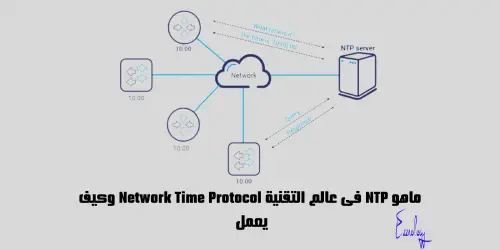
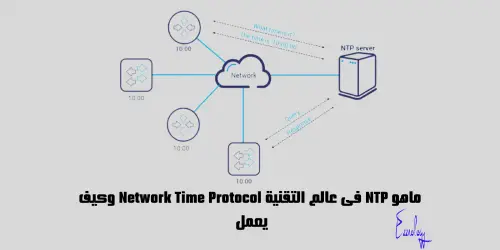
Network Time Protocol (NTP) is an internet protocol used to synchronize a computer's clock with time sources on the network. NTP is considered part of the TCP/IP protocol suite, and it is one of the oldest protocols in this suite. The term NTP refers to both the protocol and the software that operates in a client-server model on computers.
NTP was developed by David Mills, a professor at the University of Delaware, in 1981. It was designed to be reliable, highly fault-tolerant, and scalable, with support for time synchronization.
How does Network Time Protocol (NTP) work?
The time synchronization process using NTP goes through three main steps:
- Initiating the time exchange: The NTP client initiates a time request exchange with the NTP server.
- Calculating delays and adjusting: After that, the client is able to calculate the link delay and the local offset, and it adjusts its local clock to match the clock on the server machine.
- Repeating the exchanges: The process usually requires six exchanges over five to ten minutes to initially set the clock.
Once synchronization is achieved, the client updates its clock approximately every ten minutes, and this usually requires the exchange of only a single message, in addition to the synchronization process between the client and the server. This exchange occurs over the UDP protocol on port 123. NTP also supports broadcast synchronization for the clocks of computers connected to the network.
Why is Network Time Protocol (NTP) important and how is it used?
The accuracy of time for all devices on a computer network is vital for many reasons, as differences of even a fraction of a second can cause problems.
Some examples of how NTP is used include:
- Distributed procedures: Distributed operations depend on coordinated timing to ensure correct sequences are followed.
- Security mechanisms: Security mechanisms depend on maintaining consistent time across the network to ensure data integrity.
- File system updates: File system updates that are executed across multiple devices depend on synchronized clock timing to ensure no data is lost.
- Network acceleration and network management systems: These systems rely on the accuracy of timestamps to measure performance and troubleshoot problems.
Thanks to NTP, networks can maintain precise time coordination, which contributes to improving efficiency and security.
What are the features of Network Time Protocol (NTP)?
There are thousands of NTP servers around the world, which have access to extremely accurate atomic clocks and Global Positioning System (GPS) clocks. These time services require specialized receivers to communicate directly with NTP servers. It is neither practical nor economically efficient to equip every computer with one of these devices. Instead, certain computers designated as primary time servers are equipped with these receivers, and they use protocols such as NTP to synchronize the clock times of computers connected to the network.
The main features of NTP include:
- High accuracy: NTP uses Coordinated Universal Time (UTC) to synchronize computer clock times with high precision.
- Accuracy in small networks: Synchronization accuracy in local area networks (LAN) can reach 1 millisecond, while it is within tens of milliseconds over the internet.
- No time zone calculation: NTP does not take time zones into account; instead, it relies on the host device to perform those calculations.
Thanks to these features, NTP is considered an essential tool for achieving accurate and consistent timing across various networks.
What are Stratum Levels?
Stratum levels (strata) are defined as the degrees of separation from a Coordinated Universal Time (UTC) source. The different stratum levels include the following:
- Stratum 0: This is a reference clock that receives the true time from a dedicated transmitter or a satellite navigation system. It is classified as stratum 0.
- Stratum 1: This is a device directly linked to the reference clock.
- Stratum 2: This is a device that receives its time from a device classified as stratum 1.
- Stratum 3: This is a device that receives its time from a device classified as stratum 2.
The stratum classifications continue beyond that, with accuracy decreasing with each additional degree of separation.
Security aspects of NTP
On the security front, NTP suffers from known vulnerabilities. The protocol can be exploited and used in denial-of-service attacks for two reasons:
- The protocol responds to a data packet with a spoofed IP address.
- At least one of its built-in commands sends a long reply to a short request.
These vulnerabilities require taking the necessary precautions to ensure network security.
What are the advantages of NTPv4?
NTPv4 is the current version of the Network Time Protocol, and it was introduced by the Internet Engineering Task Force in Request for Comments (RFC) 5905 in 2010. NTPv4 is capable of being compatible with the previous version NTPv3, which is based on RFC 1305 and dates back to 1992. It is also compatible with other versions of NTP.
The advantages of NTPv4 include:
- Modified protocol header: NTPv4 supports the IP version 6 address family, ensuring its integration with modern networks.
- Improved algorithms: The mitigation and discipline algorithms have been improved, enhancing accuracy to reach tens of microseconds, making it ideal for workstations, laptops, mobile devices, and local area networks (LAN).
- Server discovery function: NTPv4 includes a function that facilitates determining the server configuration, making setup and management easier.
How is time information obtained?
Network devices can poll host servers and listen for NTP broadcasts to obtain time information.
Poll-based NTP associations
The most common poll-based association modes are client mode and symmetric active mode. These modes provide a high degree of accuracy and reliability for timing.
- Client mode: Network devices are assigned to time-providing hosts that they poll to obtain the correct time. The device chooses the host to synchronize with and does not provide any information back to the host. This approach is considered best for clients such as file servers and workstations that do not synchronize with other clients.
- Symmetric active mode: The device polls its host to obtain the correct time, and it also responds to polls from its hosts, gathering time-related information from network devices. This mode works best when multiple servers are connected using diverse network paths.
Broadcast-based associations in NTP
Broadcast-based associations in NTP are less accurate and reliable compared to poll-based ones, but they are effective in local networks with limited bandwidth or memory and central processing unit (CPU) resources.
Broadcast mode in NTP
In broadcast mode, network devices listen for NTP broadcast packets sent by time servers. Time information flows in only one direction, making this method suitable for local networks that require basic synchronization without the need for complexities.
What is Simple Network Time Protocol (SNTP)?
NTP may be too complex for some systems, so Simple Network Time Protocol (SNTP) is available. SNTP is considered a simplified version of NTP, as it lacks some of the internal components.
Features of SNTP
- Synchronization with NTP servers: SNTP synchronizes time with NTP servers.
- Developed for small computers: It was developed for less powerful computers, meaning it requires less memory and CPU resources compared to NTP.
- Part of TCP/IP: SNTP uses the UDP protocol on port 123.
- Used in simple applications: SNTP is used in applications that do not require precise time synchronization.
Thanks to these features, SNTP is considered an ideal choice for systems that need simple and effective timing without the complexities associated with NTP.
And here, dear brothers and sisters, we have successfully completed the mission ✌
Do not forget our brothers in Palestine in your prayers📌
Please accept the greetings of the #Ezznology #Ezz_Tech team
You can also browse our store's products from here 👈#our_store 🌷or here
To join our family on the Telegram group from👈hereand also the Facebook group, where we share information and help members, from👈here


Others were also interested in:
What is an eSIM, which devices support it, and does your phone support it or not
How to create your CV on Wikipedia
The 6 most important methods and tips for managing change effectively
Settings you can adjust on iPhone phones to improve battery life
Ezznology عز التقنية
Writer at Ezznology عز التقنية — sharing the best tech articles and tutorials.
Rate this article
💬 Comments 0
No comments yet — be the first to comment!
✏️ Leave a Comment
Related Articles

Instagram Launches New Instants App


Apple Prepares to Launch New Tools in iOS 27